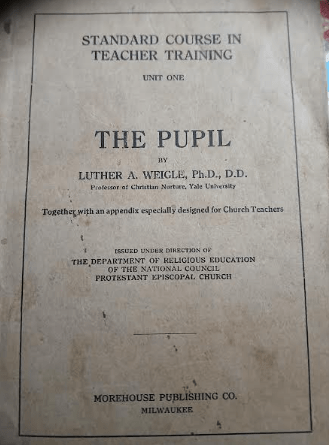
“I have a physical copy of The Pupil and the Teacher by Luther A. Weigle (1911), a classic gem on child psychology, development, and truly effective teaching—originally written for Sunday school teachers but packed with profound insights that apply perfectly to homeschooling today. In an era of flashy apps, shifting curricula, and endless digital distractions, this book reminds us that the best education starts with deeply understanding the child: their physical needs, instincts, habits, will, and spiritual growth through every stage—from early childhood wonder to adolescent questioning.
Weigle draws on timeless principles (rooted in careful observation and faith) to show how teachers (or parents) can guide real character formation, attention, moral reasoning, and a living relationship with truth—rather than just memorizing facts.
Sometimes the old ways truly are the best: they focus on the human heart and mind in a way that modern methods often overlook. This little volume has shaped generations of educators because its wisdom doesn’t expire—it’s practical, thoughtful, and soul-nourishing for raising thoughtful, grounded children at home.
If you’re homeschooling and want a resource that goes beyond surface-level techniques to the why and how of nurturing young minds and spirits, this is one worth hunting down (reprints are available online or through used booksellers). Have you ever revisited an ‘old-school’ education book that transformed your approach? What timeless principles from past educators do you find most valuable in your homeschool today? I’d love to hear—maybe it’ll inspire someone else to add this classic to their shelf!”
Outline of “The Pupil and the Teacher” by Luther A. Weigle
“The Pupil and the Teacher” (1911, 1917, 1918) by Luther A. Weigle, Ph.D., D.D., is a practical textbook designed primarily for training Sunday school teachers, though its principles apply broadly to education, especially in religious and moral contexts. Commissioned by the Lutheran Publication Society and adopted by various denominations, the book emphasizes understanding child development from psychological, physical, and spiritual perspectives to foster effective teaching. It draws on educational psychology of the era, focusing on the dynamics between pupil and teacher to promote moral and religious growth.
The book is structured in two main parts: Part I examines the pupil’s nature and development, while Part II addresses teaching methods and the teacher’s role. There are no formal subheadings within chapters in the table of contents, but the content explores topics through discussions, examples, and practical advice.
Below is a detailed outline based on the book’s table of contents, with brief summaries for each chapter derived from the overall themes and available descriptions. Summaries are inferred from chapter titles, historical context, and reviews (e.g., it’s described as a philosophical exploration of teaching dynamics, emphasizing communication, trust, and spiritual goals in Sunday school settings).
The book totals about 217-222 pages, with chapters building progressively.
Part I — The Pupil
This section (approximately pages 9-99) focuses on the psychological, physical, and moral development of the child or adolescent as the “pupil.” Weigle views the pupil not just as a recipient of knowledge but as an active, developing individual influenced by instincts, habits, and environment. It provides teachers with insights into age-specific characteristics to tailor religious education effectively.
I. The Teacher’s Work and Training (Page 9)
Introduces the foundational role of the teacher in religious education, outlining the scope of their responsibilities and the necessary personal and professional training. Emphasizes that effective teaching begins with self-preparation, including understanding one’s own faith and pedagogical skills.
II. Physical Activity (Page 15)
Discusses the importance of physical health and activity in a pupil’s overall development, arguing that bodily well-being supports mental and spiritual growth. Covers how physical needs influence learning and suggests ways teachers can incorporate activity into lessons.
III. Early Childhood (Page 22)
Examines the characteristics of young children (roughly ages 3-6), including curiosity, imagination, and basic sensory experiences. Highlights how to nurture early religious concepts through simple stories and play, avoiding complex doctrines.
IV. Middle Childhood (Page 30)
Focuses on children around ages 7-9, a period of increasing independence and concrete thinking. Discusses building habits of obedience, memory work for Bible verses, and fostering a sense of community in the classroom.
V. Later Childhood (Page 38)
Addresses ages 10-12, where pupils develop greater reasoning and social awareness. Explores moral decision-making, peer influences, and introducing more structured religious teachings like prayer and ethical stories.
VI. Early Adolescence (Page 47)
Covers the transitional phase (ages 13-15), marked by physical changes, emotional volatility, and emerging self-identity. Advises on handling doubts, encouraging personal faith commitments, and using group activities to channel energy.
VII. Later Adolescence (Page 56)
Deals with older teens (ages 16-18), emphasizing intellectual growth, vocational interests, and deeper spiritual questions. Stresses guiding pupils toward mature religious convictions and life application of faith.
VIII. Instinct (Page 65)
Explores innate instincts (e.g., play, curiosity, fear) as foundational to behavior and learning. Explains how teachers can harness these for positive religious education, transforming natural drives into moral strengths.
IX. Habit (Page 72)
Discusses the formation of habits, both good and bad, and their role in character building. Provides strategies for teachers to instill habits like regular Bible study and ethical conduct through repetition and reinforcement.
X. The Will (Page 80)
Analyzes the development of willpower and self-control, linking it to moral and religious choices. Offers guidance on helping pupils strengthen their will against temptations, using biblical examples.
XI. Morality and Religion (Page 89)
Integrates moral development with religious faith, arguing that true morality stems from a relationship with God. Covers stages of ethical reasoning and how teachers can foster genuine spirituality.
Part II — The TeacherThis section (approximately pages 103-217) shifts to practical pedagogy, viewing the teacher as a facilitator of the pupil’s growth. It emphasizes methods that promote active learning, attention, and spiritual transformation, with Jesus as the ultimate model.
XII. Grades (Page 103)
Outlines the organization of pupils into age-graded classes for effective instruction. Discusses benefits of grouping by developmental stage and adapting curricula accordingly.
XIII. Methods of Teaching (Page 112)
Surveys various teaching approaches, such as lecture, discussion, and experiential learning, tailored to religious education. Stresses interactive methods over rote memorization.
XIV. The Plan of the Lesson (Page 121)
Guides teachers in structuring lessons with clear objectives, introduction, development, and application. Includes tips for integrating Bible passages and real-life relevance.
XV. The Pupil at Work (Page 131)
Emphasizes active pupil involvement, such as assignments, projects, and self-expression, to deepen understanding and retention of religious truths.
XVI. Attention and Apperception: Principles (Page 142)
Explains psychological principles of attention (focus) and apperception (relating new ideas to prior knowledge). Discusses how these enhance learning in a religious context.
XVII. Attention and Apperception: Methods (Page 154)
Provides practical techniques to capture and sustain attention, like using visuals, stories, and questions, while connecting lessons to pupils’ experiences.
XVIII. Questions (Page 169)
Details the art of questioning to stimulate thought, check understanding, and encourage discussion. Differentiates between types of questions and their uses in teaching faith.
XIX. The Class as a Social Institution (Page 182)
Views the classroom as a community, promoting cooperation, leadership, and mutual support. Addresses discipline, group dynamics, and building a supportive environment for spiritual growth.
XX. The Spiritual Goal (Page 195)
Defines the ultimate aim of teaching as spiritual transformation, leading pupils to a personal relationship with Christ. Discusses measuring success beyond knowledge to changed lives.
XXI. The Ideal Teacher: Jesus (Page 210)
Presents Jesus as the model teacher, analyzing his methods, compassion, and effectiveness. Encourages teachers to emulate his approach in love, wisdom, and adaptability.
The book concludes without a formal epilogue but reinforces that teaching is a sacred calling, blending psychology with theology. Reviews from the era praise its accessibility and practicality, noting it lacks bibliographies but encourages further study.
If you have any questions, comment below and we will do our best to open our copy and answer you.
The Montessori Way
Maria Montessori (1870–1952), the pioneering Italian physician and educator, revolutionized our understanding of child development through decades of careful observation in her “Children’s Houses” and beyond.
Her theory emphasizes that children are naturally eager learners with an innate drive toward growth, independence, and self-construction. Unlike traditional views of children as blank slates needing direct instruction, Montessori saw development as a series of predictable, transformative stages where the child absorbs the world like a sponge—especially in the early years.Here are some classic historical portraits of Maria Montessori herself, capturing her thoughtful and groundbreaking spirit: montessori-ami.org
Key Principles of Montessori’s Child Development TheoryMontessori’s approach is holistic, focusing on the whole child—physical, cognitive, emotional, social, and spiritual.
Core ideas include:
The Absorbent Mind — Especially from birth to age 6, children unconsciously and effortlessly absorb impressions from their environment, forming their personality, language, and understanding of the world.
Sensitive Periods — Temporary “windows of opportunity” when children are intensely motivated and capable of mastering specific skills with ease and joy. Missing or interrupting these can make later learning harder, though not impossible.
Planes of Development — Four broad, six-year stages (like “rebirths”) where the child’s needs, characteristics, and learning style shift dramatically. Each plane builds on the previous one.
These principles guide the famous prepared environment in Montessori classrooms: child-sized furniture, hands-on materials, freedom of choice, and minimal adult intervention—allowing self-directed learning.Sensitive Periods (Primarily Birth to Age 6) Montessori observed that young children enter phases of heightened interest and focus on particular skills.
During these periods, they concentrate deeply, repeat activities tirelessly, and show frustration if needs aren’t met (e.g., the “terrible twos” often stem from unmet needs for order or movement).Here are visual charts illustrating the main sensitive periods (typically overlapping, with approximate ages): themontessoriroom.com
Common sensitive periods include:Movement (birth–4 years): Drive to develop coordination, from grasping to walking and climbing.
Language (birth–6 years): Explosion in speaking, vocabulary, and later writing/reading; ideal for multilingual exposure.
Order (peaks around 2 years): Craving routine, predictability, and exact placement of objects for inner security.
Small Objects (around 1–4 years): Fascination with tiny details, refining fine motor skills.
Refining the Senses (birth–6 years): Sensorial exploration to sharpen sight, touch, sound, etc.
Social Aspects/Grace & Courtesy (around 2–6 years): Learning manners, empathy, and group harmony.
In Montessori settings, materials and activities are timed to these periods for effortless mastery.The Four Planes of DevelopmentMontessori described human growth in four six-year “planes,” each with distinct characteristics and needs.
The first two are foundational for learning; the later ones apply acquired skills.Here’s a helpful diagram of the planes, often shown as triangles or waves to represent growth spurts and consolidation: amshq.org
First Plane (0–6 years): “The Absorbent Mind” — Rapid construction of the self. Subdivided into unconscious (0–3) and conscious (3–6). Focus: independence, sensory exploration, language, order. This is the prime time for Montessori’s early childhood programs.
Second Plane (6–12 years): “The Reasoning Mind” — Shift to imagination, abstract thinking, morality, and social exploration. Children become curious about the world, history, and fairness.
Third Plane (12–18 years): Adolescence — Identity formation, emotional intensity, peer focus, and questioning authority. Needs physical activity, real-world projects, and valorization (recognition).
Fourth Plane (18–24 years): Maturity — Young adulthood, specializing knowledge, contributing to society, and achieving emotional/spiritual independence.
These planes explain why Montessori classrooms use multi-age groupings (e.g., 3–6, 6–9, 9–12) to support natural social and developmental dynamics.
Why This Matters
Today Montessori’s insights—rooted in observation over a century ago—align remarkably with modern neuroscience on brain plasticity, critical periods, and self-directed learning. In homeschooling or any setting, honoring these stages fosters confident, capable, and joyful children.If you’re drawing from classics like Luther Weigle’s work on child psychology and teaching (which we discussed earlier),
Montessori complements it beautifully by adding this child-led, developmental lens—focusing on the “absorbent” early years while building moral and spiritual growth.Do any of these stages or sensitive periods ring true for your homeschoolers right now? Or would you like tips on applying Montessori ideas at home?








 South Wind
Leave a comment