UPDATE: The Starbase team plans to have the next Super Heavy booster stacked in December, which puts it on pace with the test schedule planned for the first Starship V3 vehicle and associated ground systems. Starship’s twelfth flight test remains targeted for the first quarter of 2026.
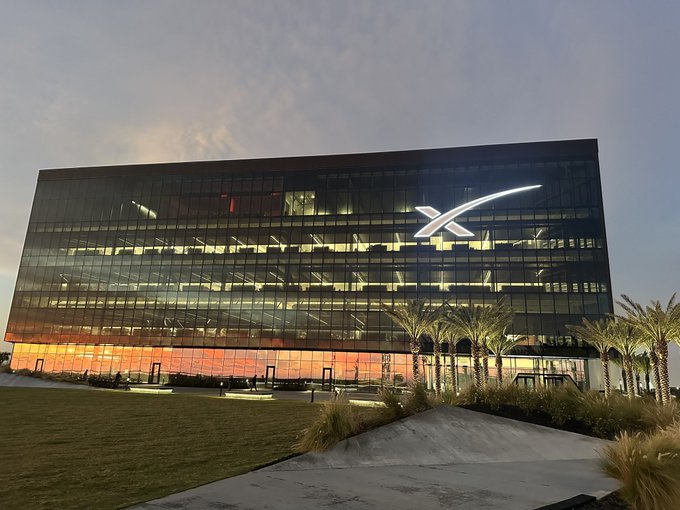
Photo: Mark Federschmidt
Starship should be able to deliver around 300 GW per year of solar-powered AI satellites to orbit, maybe 500 GW. The “per year” part is what makes this such a big deal. Average US electricity consumption is around 500 GW, so at 300 GW/year, AI in space would exceed the entire US economy just in intelligence processing every 2 years. Solar cell production for terrestrial applications is already far above this number at >1500 GW of annual production capacity.
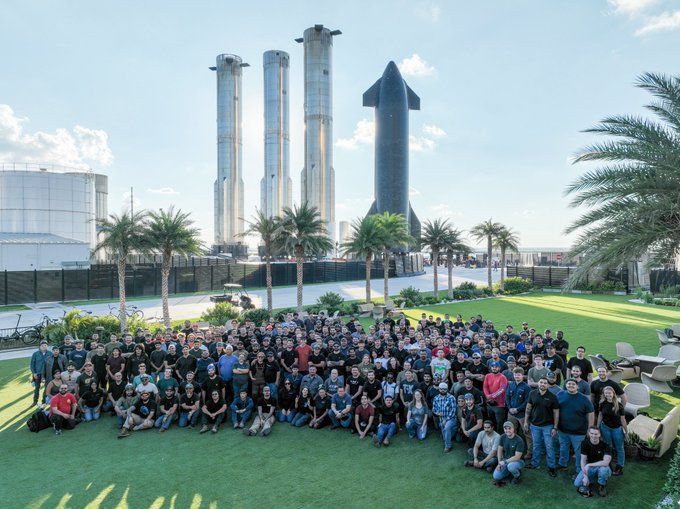
A lot of people saying the first V3 will not fly until late Spring but here we are watching B18 roll out of Megabay… all thanks to this group and so many others not pictured putting in lots of hours.
Tonnage to orbit will be solved by Starship. Chip production is therefore the major piece of the puzzle to be solved. The Tesla Terafab is needed for this, as there is otherwise no solution at sufficient scale. These numbers are immense by earthly standards, but don’t register materially on the Kardashev II scale. For that, lunar production of solar-powered AI satellites is needed to take things to the 100+ TW/year level.
Manufacturing on the Moon and a mass driver enables >100TW/year.

Starbase City updates:
CITY OF STARBASE, TEXAS 78521
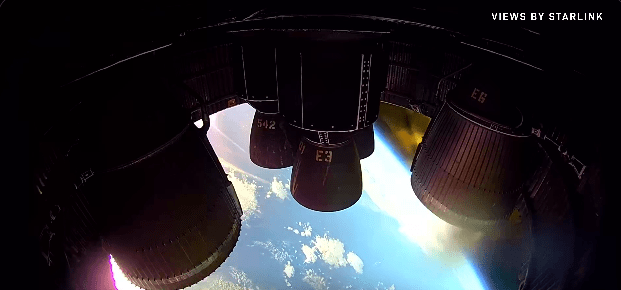
The business end of STARSHIP E3
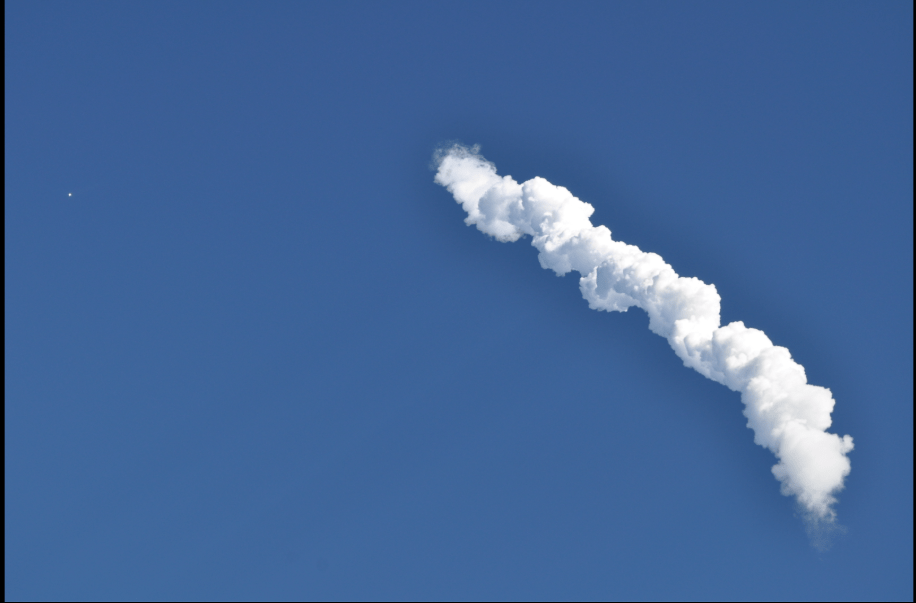


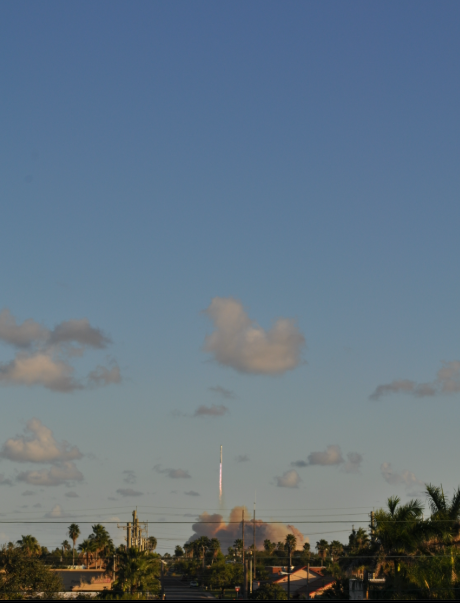

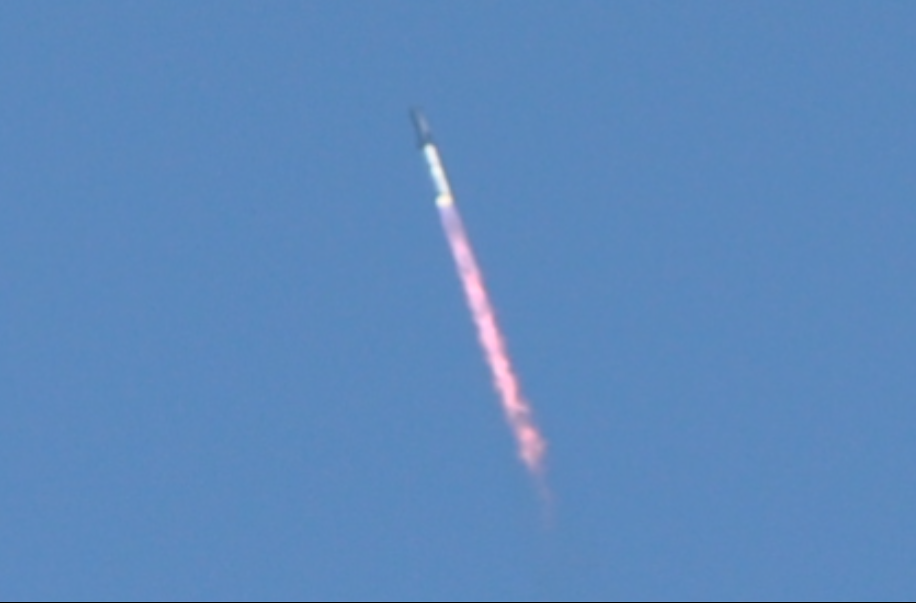
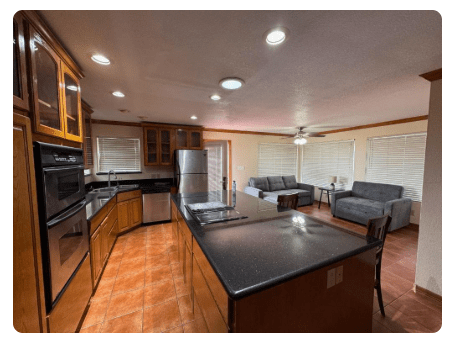
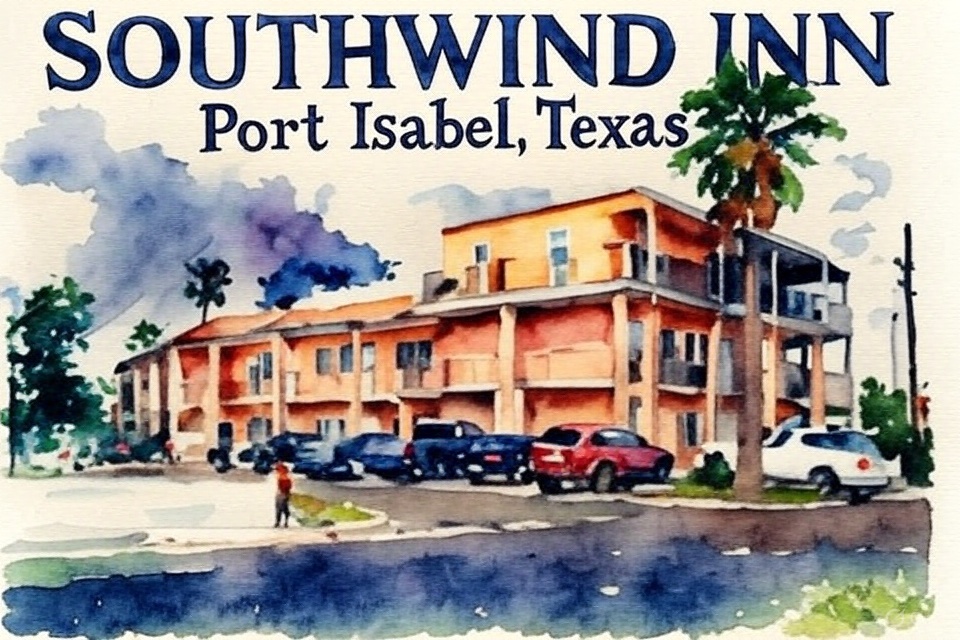
This is the view you will see in the penthouse at SouthwindInn.
Exclusive:
Inside Starbase’s rapid rise — hundreds of permits and major construction reshape SpaceX’s new city Infrastructure at SpaceX’s launch site illuminates the night sky along Boca Chica Beach in Starbase, Texas. The privately run spaceport anchors the city’s rapid growth since its incorporation earlier this year.
STARBASE — The newest city in the Rio Grande Valley is growing at rocket speed.
Since its incorporation in May, Starbase has issued nearly 150 building permits and drawn an estimated hundreds of millions of dollars in construction — from new housing and community buildings to large-scale SpaceX facilities that are reshaping the once-remote stretch of Boca Chica Highway.
Starbase has only been a city for about five months, but its inspectors have already been busy processing hundreds of building permits, records obtained by the Rio Grande Valley Business Journal show. (photo below) Space Intelligence
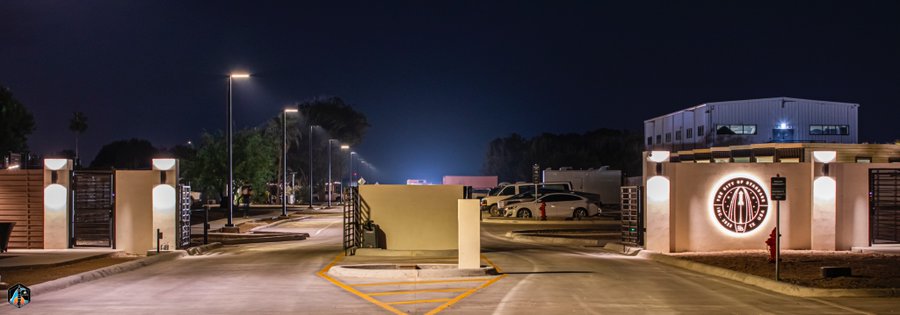
Located along a lonely stretch of Boca Chica Highway leading to the Gulf, the city serves as the epicenter of Elon Musk’s rocket company, SpaceX. Since incorporating this spring, the company town has seen a burst of residential and commercial activity as it transitions from a private enclave into a functioning municipality.
According to data compiled by the city’s subcontractor, SafeBuilt, more than 130 residential permits have been issued over the past four months, and 587 residential inspections have been completed — with a pass rate of nearly 83%.
Kent Myers “The city has just been incorporated since May, so we have seen quite a bit of residential and commercial development here,” Kent Myers, Starbase city administrator, said, in a recent interview.
During the same time frame, the city also issued 16 commercial permits and 39 commercial building inspections with a passing rate of 89%.
Most residential permits were issued in June, the data shows. Six out of 16 commercial permits were issued in September.
Details about the city’s commercial building permit applicants and projects were not immediately available online nor in person at the most recent city commission meeting, just the aggregate figures.
Starbase residents just recently won a petition for the U.S. Postal Service to add the city to its mail system, rather than Brownsville, but the city has yet to obtain a new zip code.
“I think that speaks positively to the community and our growth and expansion. We’re adding jobs, and people that work here need places to live, and so I think that’s why you’re seeing that increase,” Myers said.
On Wednesday, residents rode bicycles and walked to a Starmart retail store along brand-new sidewalks, even as utility work continued nearby.
The activity unfolded behind electric gates, erected for what the city describes as a public safety measure.
State records show several commercial construction projects have been launched inside city limits, but it was not immediately clear whether all those projects have been inspected yet.
A city under construction
Development inside Starbase has accelerated rapidly since the city’s incorporation, with a wave of construction projects ranging from infrastructure and housing to education and manufacturing. State records and permit filings show SpaceX leading much of the activity, investing tens of millions of dollars in new facilities, support buildings, and employee housing designed to expand the company’s growing footprint along Boca Chica Highway.
- In 2024, SpaceX built a six-story parking garage for $21 million along Boca Chica Highway inside what is now Starbase. In January 2025, the company filed paperwork for a $1 million “interior” power plant at SpaceX.
- In February, SpaceX filed a $189,000 construction permit for a small medical clinic inside the manufacturing site.
- In March, another parking garage and multifamily project worth $2 million — known as Grace Lot Multifamily — was filed for construction in Starbase, state records show.
- Public records also show there are dozens of children living in Starbase. In April, a $20 million school for children, known as Ad Astra Phase I, was filed to serve students from infancy to 12th grade.
- In May, the city spanned about 927 acres, mostly along Boca Chica Highway from the beach to the outskirts of Brownsville. Large portions of unincorporated land remain in between, including Cameron County tracts, Texas Parks and Wildlife property, and even federal lands.
- In June 2025, state records show a $22 million community building filed for new construction in Starbase.
- By July 2025, SpaceX’s Gigabay industrial manufacturing site — worth $250 million — was filed in state construction records.
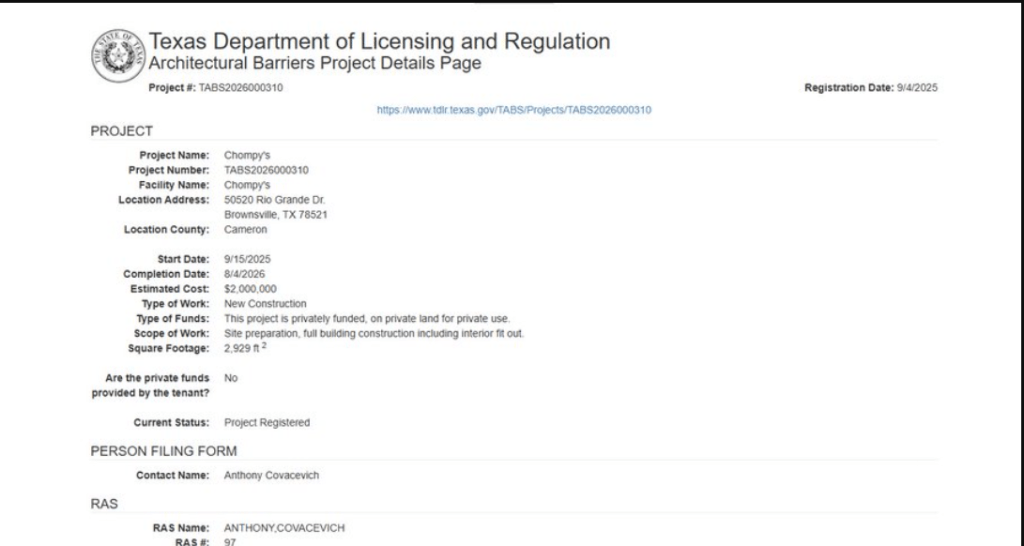
- In September, state records listed construction permits for a $2 million restaurant known as Chompy’s.
- A mixed-use development known as Rio West has been under construction since March 2024. The $8.9 million project, located several miles from SpaceX’s manufacturing site and the core of Starbase, will feature a grocery store, retail shops, a café, and employee parking.
- Inside Rio West, a separate $6 million restaurant will include an outdoor deck overlooking the Rio Grande River.
While there are quite a few hospitality amenities built or under construction inside the city, including a sushi restaurant and recreation center, there is no indication that those properties are open to the public. Nearly all are owned by SpaceX and they are heavily plastered with private property signage, armed guards, and security dogs.
In recent months, SpaceX posted a job announcement for a general manager of a hotel that would cater to its employees and guests — a position that didn’t appear to suggest the hotel would be open to the public. SPACEX.COM
Exclusive: Inside Starbase’s rapid rise — hundreds of permits and major construction reshape SpaceX’s new city By Kristen Mosbrucker-Garza
A major additional factor should be considered. Satellites with localized AI compute, where just the results are beamed back from low-latency, sun-synchronous orbit, will be the lowest cost way to generate AI bitstreams in ❤ years. And by far the fastest way to scale within 4 years, because easy sources of electrical power are already hard to find on Earth.
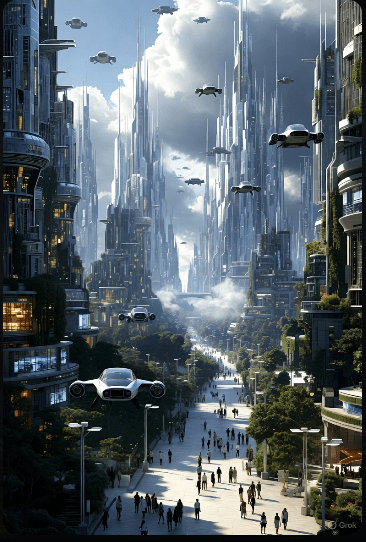
1 megaton/year of satellites with 100kW per satellite yields 100GW of AI added per year with no operating or maintenance cost, connecting via high-bandwidth lasers to the Starlink constellation. The level beyond that is constructing satellite factories on the Moon and using a mass driver (electromagnetic railgun) to accelerate AI satellites to lunar escape velocity without the need for rockets. That scales to >100TW/year of AI and enables non-trivial progress towards becoming a Kardashev II civilization.








 South Wind
Leave a comment