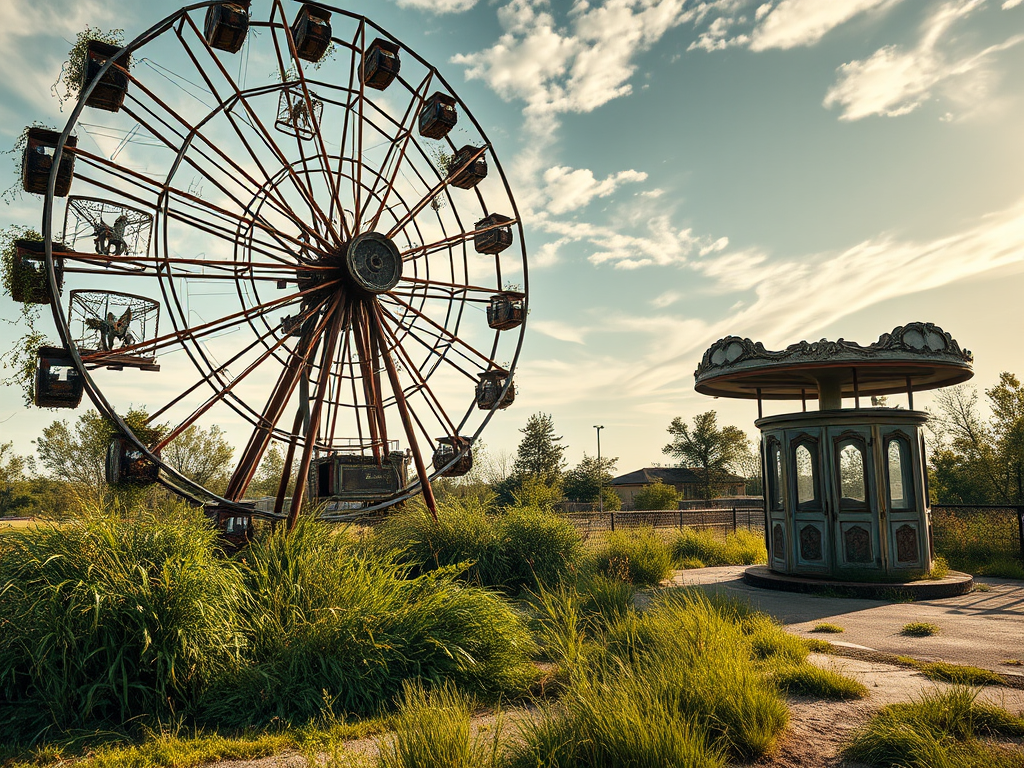
List of defunct amusement parks in the United States
https://grokipedia.com/page/List_of_defunct_amusement_parks_in_the_United_States
Defunct amusement parks in the United States comprise over 1,000 venues that provided public entertainment through rides, games, and shows but permanently ceased operations, spanning from late-19th-century origins to recent decades.[1] Many emerged as trolley parks, established by streetcar companies at urban outskirts to extend ridership into non-commute hours, evolving into destinations with picnic areas, carousels, and early roller coasters that drew millions annually by the 1910s.[2][3] At their peak around 1920, approximately 2,000 such parks operated nationwide, capitalizing on affordable thrills amid rising urbanization and leisure time.[4] Closures accelerated during the Great Depression due to unemployment curtailing discretionary spending, followed by post-World War II factors including highway construction fragmenting sites, poor management, perceptions of rowdiness, and competition from automobile-enabled travel to expansive theme parks like Disneyland.[1][5] Fires, often devastating uninsured wooden structures, and owner deaths further contributed, while later parks grappled with rising insurance costs from safety incidents and shifting preferences toward television and suburban recreation.[1] These parks defined eras of mass amusement, fostering innovations in ride technology and crowd management, yet their defunct status underscores causal economic and infrastructural shifts rather than isolated mismanagement.[6]
Introduction
Definition and Scope
A defunct amusement park refers to a fixed-location entertainment complex in the United States that featured permanent or semi-permanent mechanical rides, such as roller coasters, carousels, and Ferris wheels, along with games, shows, and food concessions, but has permanently ceased operations without reopening under its original configuration.[1] These parks differ fundamentally from temporary carnivals or traveling fairs, which rely on portable equipment and operate seasonally at varying sites without dedicated infrastructure.[7] Permanent structures and year-round or extended-seasonal intent distinguish amusement parks, enabling elaborate attractions built for longevity rather than mobility.[8]
The scope of defunct parks includes those operational from the late 19th century onward, encompassing early “trolley parks” developed near urban streetcar lines to boost ridership, mid-20th-century family-oriented venues, and later theme parks with immersive elements, all of which closed due to factors like financial insolvency, urban development, or safety concerns.[9] According to the National Amusement Park Historical Association (NAPHA), approximately 1,000 such parks existed across North America, with the majority in the United States, reflecting waves of openings in the early 1900s followed by widespread closures post-World War II amid suburbanization and rising operational costs.[1] This list excludes water parks unless they integrated traditional dry-land rides, seasonal festivals without fixed rides, and sites repurposed entirely for non-entertainment uses while still structurally intact but non-operational (often termed “standing but not operating”).[10] Focus remains on verifiable closures where the park’s core amusement function ended, prioritizing historical records over anecdotal claims.
Historical Context
Amusement parks in the United States trace their origins to the late 19th century, emerging primarily as “trolley parks” developed by electric streetcar companies to boost off-peak ridership. These facilities began as simple picnic groves and beer gardens at the ends of trolley lines, offering working-class urbanites affordable day trips with basic rides and entertainments. The first permanent enclosed amusement park opened as Sea Lion Park on Coney Island in 1895, marking a shift toward dedicated entertainment venues with ticketed admissions and themed attractions.[11] This model quickly proliferated, with Steeplechase Park following in 1897 on the same site, emphasizing mechanical rides like its namesake horse race simulator.[12]
The 1893 World’s Columbian Exposition in Chicago catalyzed widespread adoption of spectacle-driven amusements, introducing the Ferris wheel and midway-style concessions that influenced park designs nationwide. Construction boomed in the early 1900s, yielding elaborate parks such as Luna Park in 1903 and Dreamland in 1904, both on Coney Island, which featured millions of electric lights and grand architecture to create immersive fantasies. By 1920, more than 1,500 amusement parks operated across the country, catering to a growing middle class via roller coasters, carousels, and live performances.[13] [14]
Economic downturns eroded this expansion; the Great Depression in the 1930s reduced discretionary spending, while World War II from 1941 to 1945 imposed material shortages and gasoline rationing that curtailed attendance. Postwar shifts further pressured independent operators: suburban migration and automobile ownership enabled longer-distance travel, favoring destination theme parks like Disneyland, which opened in 1955 and pioneered narrative immersion over mere thrill rides.[15] Smaller parks, often family-owned and reliant on local patronage, faced escalating maintenance demands for aging wooden structures amid rising safety standards and competition from corporate chains.[11] This combination precipitated closures, with hundreds shuttering by the 1960s as the industry consolidated toward fewer, larger venues.[13]
Primary Causes of Closure
Economic and Competitive Factors
The Great Depression precipitated widespread closures among U.S. amusement parks, with the number of operating parks plummeting from 1,800–2,000 in 1930 to just 245 by 1939, driven by diminished consumer spending, reduced transit ridership, and escalating insurance costs amid neglected maintenance.[16] World War II compounded these pressures through material shortages and rationing, hindering repairs and expansions, though postwar economic recovery and the baby boom temporarily revived attendance in surviving venues.[16] These eras established a pattern where financial vulnerability—exacerbated by reliance on local, discretionary income—rendered many parks susceptible to macroeconomic shocks.
Postwar suburbanization and the rise of automobile-dependent lifestyles eroded the viability of urban trolley parks, which depended on mass transit for patronage, while the 1955 opening of Disneyland introduced themed immersion and family-centric programming that outcompeted traditional ride aggregations lacking cohesive narratives or reinvestment.[17] Regional parks, comprising 74% of closures from 1955 to 2009, struggled against destination resorts drawing broader audiences, with 39% of failed operations citing low customer satisfaction from outdated attractions and capacity constraints.[6] Market saturation in localized areas further intensified competition, as fragmented operators failed to scale against conglomerates offering superior marketing and variety.
Contemporary closures reflect chronic undercapitalization and operational inefficiencies, with 70% of analyzed failed parks from the mid-20th century onward burdened by excessive debt and 87% experiencing bankruptcy or temporary shutdowns due to cash flow deficits.[6] Inflationary pressures on maintenance, utilities, and insurance—evident in 2025 reports of surging costs amid economic uncertainty—have squeezed margins, particularly for aging regional facilities.[18] Corporate mergers, such as the 2024 Cedar Fair-Six Flags combination, have accelerated rationalization, closing underperformers like Six Flags America in 2025 to alleviate debt and capitalize on land redevelopment, where 35% of failures involved sites repurposed for higher-yield uses.[19][6]
Safety Incidents and Liability Issues
Safety incidents at amusement parks, including mechanical failures, operator errors, and inadequate maintenance, have occasionally precipitated liability crises through personal injury lawsuits, substantial settlements, and escalating insurance premiums, thereby contributing to operational insolvency for certain defunct facilities. While economic factors dominated most closures, severe accidents eroded public confidence, triggered regulatory interventions, and imposed financial burdens that some smaller or mismanaged parks could not sustain. For instance, over 100 lawsuits were filed against operators in high-profile cases, with settlements and defense costs straining resources already vulnerable to competition and downturns.[20][21]
Action Park in Vernon Township, New Jersey, exemplifies how recurrent safety failures culminated in closure due to liability overload. Opened in 1978, the park featured unregulated attractions like the Cannonball Loop slide and high-speed alpine slides, resulting in at least six fatalities and thousands of injuries over its operation, including drownings, spinal fractures, and cardiac events from unmonitored wave pools. These incidents spawned numerous “class action” lawsuits—earning the park its derisive nickname—and prompted New Jersey authorities to revoke its insurance coverage in 1987 after revoking operating certificates for several rides. Mounting legal fees, settlements exceeding millions, and prohibitive insurance hikes forced the park’s permanent shutdown in 1996, followed by bankruptcy in 1998.[20][22]
Similarly, the 1930 Big Dipper roller coaster derailment at Krug Park in Omaha, Nebraska, accelerated the park’s decline through liability and reputational damage. On July 24, four cars plummeted 35 feet after a coupling failure, killing four riders and injuring 17 others in what remains one of the deadliest U.S. coaster accidents. The tragedy prompted immediate ride demolition, a local ordinance banning roller coasters, and a sharp drop in attendance amid the onset of the Great Depression. Although Krug Park limped on until 1940, the incident’s lawsuits and eroded patronage were pivotal in its demise, highlighting how catastrophic events could overwhelm liability protections for pre-regulatory era operators.[23][24]
Such cases spurred broader industry reforms, including federal oversight via the U.S. Consumer Product Safety Commission established in 1973 and state-level ride inspection mandates, which indirectly raised operating costs for liability-prone parks. However, closures directly attributable to safety-driven liability remain outliers, as most defunct parks succumbed to fires, economic shifts, or urban development rather than isolated incidents.[25][26]
Natural Disasters, Fires, and Other Events
Numerous early-20th-century amusement parks were constructed primarily from highly flammable wood, rendering them vulnerable to devastating fires that often led to permanent closures. Dreamland Park in Coney Island, New York, exemplified this risk; opened in 1904 as a lavish electric-lit spectacle rivaling Luna Park, it was entirely consumed by flames on the night of July 13, 1911, due to an electrical short or possible arson, with firefighters hampered by dry hydrants and strong winds.[27] The inferno spread rapidly across its 15 acres, destroying rides, theaters, and lagoons, and the park never reopened amid high rebuilding costs and insurance disputes.[27]
Similar fates befell other wooden-era parks, such as Joyland in Sacramento, California, where a June 21, 1920, blaze ignited by faulty wiring razed most attractions including roller coasters and pavilions, prompting closure without reconstruction due to financial strain. In Youngstown, Ohio, Idora Park’s April 26, 1984, fire—sparked in a storage area—gutted key structures like the Wild Cat roller coaster and concessions, accelerating its decline and final shuttering in 1987 after decades of operation.[28] Playland-the-Seattle, a post-war staple, suffered a massive August 18, 1953, conflagration that billowed smoke over the city and damaged iconic rides, contributing to its eventual 1960s closure amid safety concerns and urban shifts.[29]
Natural disasters inflicted lasting damage on coastal and riverine parks. Six Flags New Orleans, rebranded from Jazzland in 2002, was inundated by 4 to 7 feet of floodwater from Hurricane Katrina’s levee failures on August 29, 2005, with stagnant waters persisting for over a month and causing structural corrosion, mold, and wildlife infestation across its 140 acres.[30] Operators deemed repairs prohibitive at an estimated $120 million, leading to abandonment; the site remained a decaying landmark until demolition began in January 2025 for redevelopment.[31] [32]
Flooding repeatedly threatened inland parks near major waterways. Coney Island in Cincinnati, Ohio—a 130-year-old riverside venue with coasters like the Zodiac—faced chronic Ohio River overflows, culminating in severe inundation during 1960s floods that eroded profitability and prompted its 1969 closure; its assets were relocated to the inland Kings Island to evade future deluges.[33] The 1937 Ohio River flood similarly crippled operations at parks like Euclid Beach in Cleveland, where weeks of submersion damaged electrical systems and rides, hastening postwar decline despite partial recovery.[28]
Other events, including structural failures exacerbated by weather, sealed some parks’ fates. Superstorm Sandy’s October 2012 surge demolished sections of Casino Pier in Seaside Heights, New Jersey, toppling the Jet Star roller coaster into the Atlantic and inflicting over $1 million in damages to 40 of 44 rides, though partial rebuilding occurred; persistent erosion and costs contributed to ongoing instability.[34] These incidents underscore how environmental forces, combined with aging infrastructure, often rendered revival unviable without massive intervention.
List of Parks by State
Alabama
Canyon Land Park, located in Fort Payne, operated from 1970 to approximately 1977 and featured amusement rides, a chairlift to Little River Canyon overlook, swimming areas, and picnicking facilities.[35]
East Lake Park, in Birmingham, opened in 1886 with a lake, hotel, Ferris wheel, and roller coaster; the city acquired it in 1917 and added more rides, which were refurbished in the 1920s and 1970s before removal in the early 20th century.[35]
Electric Park, Montgomery, established in 1904 to promote electric streetcars, included a theater, water slide, carousel, and boat rides; it closed in the early 20th century amid rising automobile use and movie popularity.[35]
Gulf Shores Amusement Park, in Gulf Shores, operated as a kiddie park with a roller coaster and Ferris wheel until its destruction by Hurricane Ivan in 2004, after which it did not reopen.[35]
Idle Hour Amusement Park, Phenix City, ran from 1938 to the early 1960s, offering a zoo, rides, games, bowling, and dancing; it attracted visitors including soldiers from nearby Fort Benning.[35]
Kiddieland Park, at the Alabama State Fairgrounds in Birmingham, provided children’s rides until its closure around 2001 following the dissolution of the fair authority.[35]
Lake City Amusement Park, Guntersville, opened in 2016 with 35 rides but shut down after three months due to loss of financial backing.[35][36]
Pickett Springs, Montgomery, active from the 1880s until around World War I, included a dance pavilion, carousel, and roller coaster; its decline paralleled the growth of automobiles and motion pictures.[35]
Sertoma Playland, Huntsville, operated from the 1960s to 1998, featuring a train, roller coaster, and kiddie rides; some equipment was later transferred to Southern Adventures upon closure.[35]
Southern Adventures, Huntsville, ran from 1998 to 2018 and included a water park, roller coaster, go-karts, and rides acquired from Sertoma Playland.[35][37]
Styx River Water World, Loxley, a water park with miniature golf and rides, closed in 2001, leaving ruins that became a local landmark.[35]
Washington Park, Montgomery, opened in 1904 as a segregated facility for Black visitors, featuring game booths, a pavilion, and baseball field.[35]
Arizona
Legend City was an 87-acre amusement park located on the border between Phoenix and Tempe, Arizona, opening on June 29, 1963, and closing permanently in 1983.[38] Initially themed as an Old West attraction with stagecoach rides, a saloon, and family-oriented exhibits, it evolved under multiple owners to include thrill rides like the Cloud Nine roller coaster and hosted local TV shows such as Wallace and Ladmo.[39] The park faced early financial troubles, filing for bankruptcy in 1964 due to unpaid taxes and insurance, and changed hands four times amid declining attendance and operational challenges.[40] Its closure stemmed from the sale of its land to the Salt River Project for development, marking the end of operations despite nostalgic local appeal.[39]
Bedrock City, a Flintstones-themed roadside attraction in Valle, Arizona, near the Grand Canyon, operated from 1972 until its closure on January 28, 2019.[41] Featuring concrete dinosaurs, replica caves, a water slide, and character meet-and-greets, it drew families with low-cost prehistoric play areas and camping options over nearly five decades.[42] The park shut down following the owner’s retirement and a $2 million property sale in 2015, with subsequent rebranding to Raptor Ranch shifting away from the Flintstones theme due to expired licensing and evolving visitor interests.[43] Remnants like statues persist as informal roadside curiosities, though no amusement operations continue.[44]
Big Surf, the world’s first surf park in Tempe, Arizona, opened in 1969 and pioneered wave pool technology, attracting surfers and families with artificial waves up to 2.5 feet high alongside slides and pools.[45] Spanning 22 acres, it operated seasonally for over 50 years but closed in 2019 amid the COVID-19 pandemic, failing to reopen due to aging infrastructure and maintenance costs.[46] The site was sold in 2022 and demolished to make way for Nextwave Tempe, a modern surf-focused development, ending its run as a historic water recreation venue.[47][48]
Kiddieland, a children’s amusement area in Phoenix’s Encanto Park, launched in 1948 with rides like a carousel, mini train, and pony track, serving as a staple for local families until its closure in 1986.[49] Owned initially by Frank and Beulah Nelson, it featured 11 attractions geared toward young visitors and persisted through ownership changes after the founders’ deaths.[50] The shutdown coincided with a $4 million Encanto Park renovation, leading to an auction of rides, though the site later reopened as Enchanted Island Amusement Park in 1990 with some original elements preserved.[51]
Arkansas
Dogpatch USA, located in Marble Falls near Harrison, operated from 1968 to 1993 as a theme park inspired by the Li’l Abner comic strip, featuring rides such as the Wild Mouse roller coaster and McGoon’s Brain Rattler toboggan.[52] The park struggled with financial issues and changing ownership before permanent closure, leaving structures that have since deteriorated.[53]
Dinosaur World in Beaver, opened in 1967 across 65 acres, showcased over 100 life-sized dinosaur statues and was once billed as the world’s largest dinosaur-themed park; it closed in 2005 amid declining attendance.[54]
Wild River Country, a 26-acre water park in North Little Rock, ceased operations in 2019 after failing to pay sales taxes, leading to an auction sale; it had been Arkansas’s largest water attraction with 13 slides and pools but faced repeated shutdowns and vandalism post-closure.[55]
Earlier 20th-century parks included Pulaski Heights Amusement Park in Little Rock (opened 1905, closure date unknown), featuring a Figure 8 roller coaster; Forest Park in Pine Bluff (opened 1908), with a similar ride built by the 20th Century Amusement Company; White City in Little Rock (opened 1908); Electric Park in Fort Smith (opened 1909), offering a Tour of the World scenic railway and Figure 8; Whittington Park in Hot Springs (opened 1910, Deep Dipper coaster added 1921); Joyland Park in Little Rock (opened 1923); Fairyland Park in Little Rock (opened 1925); and Willow Lake Amusement Park in El Dorado (1926–1927 or 1928), which included an Earthquake coaster before short-lived operation.[52] These trolley parks typically closed due to urban expansion, economic shifts, or fire hazards common to wooden structures of the era, though specific causes vary and records are sparse.
California
California’s amusement parks emerged in the late 19th century, often located near beaches or urban centers to attract crowds via streetcars and early automobiles, but many closed due to devastating fires, economic competition from emerging theme parks like Disneyland in 1955, rising operational costs, and urban renewal projects.[56] Early parks frequently suffered from wooden construction vulnerabilities to arson or accidents, while mid-20th-century venues faced declining attendance amid shifting leisure preferences and maintenance burdens.[57]
Notable defunct parks include:
Abbot Kinney Pier, Venice: Operated from 1905 to 1920, destroyed by fire in December 1920.[56]
Beverly Park, Los Angeles: A small park that ceased operations in the mid-20th century amid urban expansion.[56]
Central Park (Steeplechase Park), San Francisco: Ran approximately 1899 to 1902, closed following a fire.[56]
Chutes Park, San Francisco: Active in the 1890s until around 1902, shuttered after burning down.[56]
Marineland of the Pacific, Rancho Palos Verdes: Opened in 1954 as an oceanarium with amusement elements, closed in 1987 due to financial losses and animal welfare concerns.[56]
Pacific Ocean Park, Santa Monica: Operated 1958 to 1967, abandoned after accumulating debts and vandalism eroded viability.[58]
Playland at the Beach, San Francisco: Functioned from 1913 to 1972, demolished for residential development under urban renewal.[58]
The Pike, Long Beach: Established 1902, closed 1979 amid rising crime, infrastructure decay, and competition.[58]
These closures reflect broader patterns where initial popularity waned against modern safety standards and entertainment alternatives, leaving remnants like piers or ruins as historical markers.[59]
Colorado
Several amusement parks operated in Colorado before closing due to financial difficulties, competition, or operational challenges.
Manhattan Beach Amusement Park in Edgewater operated from 1890 to 1908 and was the first amusement park west of the Mississippi River.[60] The site later hosted Luna Park until 1914, featuring rides and attractions before financial issues led to its closure.[60]
Heritage Square in Golden opened in 1959 initially as a shopping village but evolved into an amusement park with rides, a music theater, and themed areas; it closed in 2018 amid declining attendance and maintenance costs.[61] [62]
Magic Mountain near Golden debuted in the late 1950s with ambitious plans for family entertainment but shut down shortly after opening in 1960 due to construction debts and foreclosure, leaving many attractions unfinished.[63]
Guyton’s Fun Junction in Grand Junction ran from 1954 to 1999, serving as the largest amusement park between Denver and Salt Lake City with roller coasters, bumper cars, and family rides; it closed owing to rising operational expenses and insufficient revenue.[64] [65]
Buckskin Joe Frontier Town and Railway in Cañon City functioned from 1958 to 2010 as an Old West-themed park with stagecoach rides, gunfights, and a narrow-gauge railway; it attracted over a million visitors annually at its peak but ended operations due to economic pressures, with structures relocated afterward.[66] [67]
Connecticut
Savin Rock Amusement Park, located in West Haven, began as a beach resort in the 1870s and evolved into a full amusement park, initially branded as White City in 1903 with electric-lit towers, roller coasters, funhouses, and a miniature train. It operated until its final closure on September 21, 1966, driven by declining attendance, rising crime, multiple fires, and municipal redevelopment into residential and commercial areas.[68][69][70]
Luna Park in West Hartford opened in 1906, offering rides, circus acts, and events like hospital benefits, but was razed in the 1930s to accommodate a Pratt & Whitney aircraft factory amid industrial expansion.[71][72]
Suburban Park in Unionville (now part of Farmington) functioned from 1895 to 1905, constructed by the Hartford Suburban Trolley Line with attractions including a dance hall, picnic groves, paddle boats on a scenic lake, and one of the first electrified fountains; it closed after a decade, leaving remnants now accessible via hiking trails.[73][74]
Pleasure Beach Amusement Park in Bridgeport operated from around 1904 to 1958, featuring a roller coaster and other rides alongside beach access, but shuttered due to a $26,000 annual deficit, a 1953 fire damaging key structures, and subsequent sales; remaining rides were auctioned in 1961, leading to abandonment until partial beach reopening in later years without full amusement operations.[75][76]
Delaware
Brandywine Springs Amusement Park in Wilmington operated from 1887 to 1923 as a trolley park featuring an artificial seven-acre lake, pavilion, electric lighting, powered boats, and various rides accessible via the People’s Railway.[77] [78] Originally developed around natural chalybeate springs for medicinal use in the 1820s, it shifted to amusement under Richard Crook’s ownership, attracting crowds for picnics and entertainment until the rise of automobiles post-1910 diverted visitors to distant beaches, leading to its closure after the 1923 season.[77]
Shellpot Park, also in Wilmington, functioned as a trolley park from 1893 to 1934, developed by the Wilmington City Railway Company to boost ridership with features including two roller coasters and other attractions along Shellpot Creek.[79]
Deemer’s Beach Park near New Castle opened around 1925 under industrialist Seldon Deemer, offering a boardwalk, swimming pool, roller skating rink, and expanding amusements served by train, steamboat, and ferry access.[80] [81] It closed in the late 1930s due to financial difficulties, Deemer’s death, and severe hurricane damage, briefly reopening as a segregated facility before permanent abandonment.[81]
Blue Diamond Park in New Castle added amusement rides, including a roller coaster, in 2003 atop existing motorsports facilities like ATV and motocross tracks, but the ride area shuttered after 2007 with full operations ending by 2014 as owners opted not to reopen amid declining viability.[82] [83]
Smaller operations like Kiddie Towne, a children’s playground adjacent to the Ellis Drive-In in New Castle documented in 1951, existed briefly but lacked significant rides or long-term impact. Lincoln Park in New Castle appears in historical lists but with minimal verifiable details on operations or features.[84]
District of Columbia
Suburban Gardens was the only major amusement park located entirely within the boundaries of Washington, D.C.[85] Situated at 50th and Hayes Streets NE in the Deanwood neighborhood, it opened on June 25, 1921, developed by the Black-owned Universal Development and Loan Company to provide segregated recreational facilities for African American residents.[85][86] The 20-acre park included a roller coaster, Ferris wheel, swimming pool, midway games, and a dance pavilion that hosted performers such as Cab Calloway.[87][88] It closed in the early 1940s amid declining attendance and urban redevelopment pressures, after which the site was converted primarily into apartment buildings.[85][88]
Florida
Florida’s amusement park landscape has seen many closures, primarily driven by intense competition from mega-resorts like Walt Disney World and Universal Orlando, post-9/11 tourism declines, and operational costs outpacing revenues. Smaller parks struggled to attract sufficient visitors amid shifting preferences toward expansive, branded experiences. Historical records from the National Amusement Park Historical Association document over a dozen defunct parks, ranging from early 20th-century venues to mid-century Western-themed attractions.[89]
Notable examples include Six Gun Territory in Ocala, which operated from February 2, 1963, to January 1, 1984, featuring staged gunfights, a saloon, and train rides in a recreated Old West town; it shuttered due to successive poor management and ownership changes that eroded attendance.[90][91] Miracle Strip Amusement Park in Panama City Beach ran from May 25, 1963, to September 5, 2004, boasting the Starliner wooden roller coaster and beachfront rides; closure stemmed from revenue losses, unpaid bills, and waning interest following a post-9/11 slump.[92]
Cypress Gardens in Winter Haven, opened in 1936 as a botanical showcase with water ski shows, evolved into a theme park but closed on November 1, 2009, after accumulating $6 million in debts amid reduced tourism; the site later became part of LEGOLAND Florida in 2011, preserving some gardens but ending independent operations.[93][94] Splendid China in Kissimmee, a $100 million miniature replica of Chinese landmarks opened in 1993, ceased operations on December 31, 2003, hampered by low attendance, protests over forced labor allegations in its construction, and competition from nearby giants.[95][96]
Circus World in Haines City, launched in 1973 under Ringling Bros. and Barnum & Bailey, featured live performances and exhibits but folded in 1986 due to financial losses; a rebranded Boardwalk and Baseball iteration from 1987 to 1990 attempted baseball-themed attractions alongside circus elements yet failed similarly from poor draw.[97] Disney’s River Country, the resort’s inaugural water park opened June 20, 1976, on Bay Lake, halted indefinitely on November 2, 2001, as newer Typhoon Lagoon and Blizzard Beach siphoned visitors, compounded by a 2001 drowning incident and broader attendance drops.[98][99]
Earlier parks like Dixieland Park in Jacksonville (1907–1916) and Bay View Park in Pensacola offered basic rides and entertainments but succumbed to urban development and economic shifts, as cataloged in amusement industry archives.[89] These closures highlight causal factors like market saturation—Florida hosted over 20 major parks by the 1990s—and vulnerability to external shocks, with remnants often repurposed or razed for commercial use.
Georgia
Georgia has hosted several amusement parks that ceased operations due to factors including financial difficulties, competition from larger venues, and changing entertainment preferences. Notable examples include early 20th-century trolley parks and later family-oriented attractions.
Amusement park City Years of operation Notes
Ponce de Leon Amusement Park Atlanta 1903–early 1920s Developed around Ponce de Leon Springs, the park featured rides, a dancehall, and theater; it closed amid declining attendance as the area transitioned to other uses.[100][101]
The World of Sid and Marty Krofft Atlanta May 26, 1976–November 9, 1976 Georgia’s first indoor amusement park, themed around the producers’ television shows; it shut down after five months due to low visitor numbers and competition from outdoor parks like Six Flags Over Georgia.[102][103]
American Adventures Marietta May 26, 1990–March 2011 A family-oriented park adjacent to White Water Atlanta, opened with an $8.5 million investment featuring rides for children; closed permanently after operational lease issues with Zuma Holdings LLC, lack of maintenance, and management challenges.[104][105]
Idaho
White City Amusement Park in Boise opened on July 4, 1910, adjacent to the Natatorium along Warm Springs Avenue, marking the city’s first dedicated public amusement venue.[106] Inspired by the White City exposition at the 1893 Chicago World’s Fair, it featured a half-mile-long roller coaster reaching 60 feet in height, along with other rides accessible via streetcar for a nickel fare.[107] The park operated into the 1930s before closing amid the economic hardships of the Great Depression and declining patronage.[108]
Meridell Park, located south of Pocatello off South 5th Avenue, originated as a stagecoach stop in the late 1890s before evolving into a multifaceted recreational site that included an amusement park with rides, a dance hall, beer garden, and swimming facilities from approximately 1920 until the late 1960s.[109][110] It ceased amusement operations due to waning attendance and shifting leisure trends, later repurposing the site as an event center.[111]
The Natatorium in Boise, established in 1892 as a trolley-line destination resort, incorporated amusement elements such as recreational swimming and gatherings alongside its primary pool facilities, operating until closure in 1934 following structural damage from a windstorm and obsolescence.[112][113]
Wild Waters, a water-based amusement park in Coeur d’Alene, provided slides, pools, and aquatic rides from its opening until permanent closure in 2010 due to financial difficulties and ownership changes, with the site abandoned until demolition began in 2018.[114][115]
Illinois
Illinois hosted numerous amusement parks that ceased operations due to factors including financial challenges, competition, natural disasters, and urban development. Prominent examples include large-scale parks in the Chicago area that drew millions of visitors before closing mid-century.
Riverview Park in Chicago operated from July 2, 1904, until its final closure on October 3, 1967.[116] [117] The 74-acre park featured iconic rides such as the Bobs roller coaster and the Fireball, attracting generations of families.[118] It shut down amid speculation over high insurance premiums following accidents and shifting urban dynamics.[117]
White City in Chicago opened on May 26, 1905, on 14 acres at 63rd Street and South Parkway, modeled after the 1893 World’s Columbian Exposition’s White City.[119] [120] The park included electric towers, lagoons, and thrill rides, operating until approximately 1939.[121] [122] Fires and economic pressures contributed to its decline, with multiple reconstructions before permanent closure.[119]
Kiddieland Amusement Park in Melrose Park began as a pony ride operation in 1929 and evolved into a family park with about 20 rides by the mid-20th century.[123] [124] It featured the Little Dipper roller coaster, opening in 1950, and closed on September 27, 2009.[125] The site was demolished in 2010 for commercial development.[126]
Old Chicago in Bolingbrook, the world’s first indoor amusement park, opened in 1975 combining a mall with rides like the Enchanted Castle.[127] It operated until March 17, 1980, closing due to financial setbacks including fires and low attendance.[128]
Adventureland Park in Addison ran from 1961 to 1977, offering roller coasters and family attractions amid growing competition from larger venues.[129] Racial tensions and security issues were cited among factors for its closure.[129]
Other defunct parks include Al Fresco Park in Peoria (1906–1946, closed due to river flooding) and Forest Park Amusement Park (1907–1922).[130] [131]
Indiana
Indiana featured several amusement parks that operated primarily in the early to mid-20th century, with others emerging later before closing due to financial difficulties, accidents, or changing recreational trends. Notable examples include Riverside Amusement Park in Indianapolis, which drew crowds with roller coasters, a dance hall, and other attractions until its permanent closure.[132] Many smaller parks, such as those listed by the National Amusement Park Historical Association, ceased operations amid broader declines in regional amusement venues.[133]
Riverside Amusement Park, located in Indianapolis, opened on May 30, 1903, and spanned 68 years of operation, featuring rides like the Hi-Flyer roller coaster, a Ferris wheel, and a skating rink.[132] The park maintained a whites-only admission policy until 1963, after which it struggled with declining attendance and was cited as a factor in its eventual shutdown.[134] It closed permanently after Labor Day weekend in 1970, with demolition orders issued in 1978 to clear the site for redevelopment.[135]
Rose Island Amusement Park, situated on the Ohio River near Charlestown in Clark County, began as Fern Grove picnic grounds in the 1880s before Louisville businessman David B.G. Rose purchased and expanded it in 1923 for $250,000, adding a roller coaster, swimming pool, hotel, and zoo.[136] The park thrived during the 1920s but closed in 1937 due to the Great Depression and a devastating flood that damaged infrastructure.[137] During World War II, the site served as part of the Indiana Army Ammunition Plant; remnants are now accessible via hiking trails in Charlestown State Park, donated to the state in 1995.[136]
Old Indiana Fun-n-Water Park near Thorntown in Boone County opened in 1983, incorporating relocated rides from other defunct parks and offering water slides, a log flume, and family attractions.[138] It ceased operations in 1996 following a fatal accident on August 11, when a miniature train derailed, killing visitor Nancy Jones, aged 57, and injuring her granddaughter; the incident prompted immediate closure and subsequent bankruptcy.[138] Rides were auctioned off in 1997, and the site later became a hops farm.[139]
Fun Spot Amusement Park & Zoo in Angola, Steuben County, combined rides like the Afterburner roller coaster with animal exhibits and operated seasonally until closing after the 2008 season amid economic downturn and reduced group bookings.[140] The park, owned by the Trine family, sold its inventory by 2020, leaving the site abandoned.[140]
Other defunct parks include Broad Ripple Park in Indianapolis, which featured early amusement elements before transitioning to municipal use; Playland Park in Logansport; Lakeview Park in Terre Haute; and Boyd Park in Peru, among approximately a dozen documented closures tied to regional economic shifts.[133]
Iowa
Riverview Park, located in Des Moines, operated as an amusement park from May 29, 1915, until its final season in 1978.[141] Originally developed as a zoological garden and trolley park destination before 1915, it expanded to include rides such as a wooden roller coaster and other attractions, drawing families for over six decades until closure due to aging infrastructure, economic pressures, and a sale to Adventureland Resort in 1979, after which the site was not reopened as an amusement venue.[142][143]
CeMar Acres, situated on the border of Cedar Rapids and Marion, functioned as a family-oriented amusement park from the 1940s through 1968.[144] It offered rides including a Ferris wheel, Tilt-A-Whirl, a roller coaster added in 1958, a miniature train called the Hiawatha, games, and a roller rink, alongside a midget car speedway that hosted racing events.[145] The park closed in 1968 amid declining attendance and competition from larger venues.[145]
Electric Park in Waterloo, developed on a 14-acre site along the Cedar River in the early 1900s, served as a major regional amusement destination with rides including a wooden roller coaster, bandstand, and interurban rail access until its closure as a full park in the mid-1920s.[146][147] Only the Electric Park Ballroom from the original complex remains operational today, reflecting the park’s transition from a comprehensive amusement site to a venue focused on music and events.[148]
Other smaller or short-lived parks include Alamo Amusement Park (also known as Cedar Park) in Des Moines, which ran from 1906 to 1910, and Bayside Park in Clear Lake, operational in the early 20th century before fading with the decline of trolley parks.[149] These closures often stemmed from the post-World War I shift away from electric trolley parks and the impacts of economic downturns like the Great Depression.[150]
Kansas
Joyland Amusement Park in Wichita operated from 1949 until its initial closure in 2004 due to financial difficulties and infrastructure deterioration, despite annual revenues around $1.75 million at the time.[151] The park briefly reopened in 2006 under new management but failed to sustain operations and closed permanently thereafter, with most structures demolished by 2012.[152] It featured classic rides including a wooden roller coaster and was once the largest such park in central Kansas.[153]
Boyle’s Joyland in Topeka functioned as a family-oriented amusement park until its closure on October 2, 1988, after which its carousel was acquired by the city for Gage Park.[154] The site later hosted a flea market before redevelopment.[155]
Wonderland Amusement Park in Wichita ran from 1905 to 1918, when it shut down following the enactment of blue laws prohibiting Sunday theatrical performances in the park’s theater.[156]
Clown Town in Hutchinson operated between 1958 and 1979, though limited historical records detail its attractions or precise closure circumstances.[156]
Carnival Park in Kansas City, Kansas, opened on May 25, 1907, as a 13.5-acre temperance resort with rides and entertainments, but ceased operations in the early 20th century amid shifting urban development.[157][158]
Clyde White City near Dearing and Coffeyville provided attractions such as a Figure 8 roller coaster, carousel, theater, and bowling alley starting in 1907, operating into the early 1900s before fading from records.[159][156]
Kentucky
Kentucky featured numerous amusement parks that operated from the late 19th century through the late 20th century, many succumbing to fires, financial difficulties, urban development, or shifting public interests.[160] Notable examples include early trolley parks and later themed attractions.
Amusement Park Location Years of Operation Notes
Ludlow Lagoon Amusement Park Ludlow 1895–1917 An 85-acre site with a man-made lake, roller coaster, theater, and boating; one of the largest parks in the U.S. at the time, serving the Greater Cincinnati area until closure due to financial woes.[161] [162]
Fontaine Ferry Park Louisville 1905–1969 Featured over 50 rides, a theater, skating rink, and pool; closed permanently after a riot and vandalism on its 1969 opening day amid racial tensions following integration in 1964. Subsequent short-lived reopenings as Ghost Town on the River (1972–1974) and River Glen Park (1975–1976) failed due to low attendance.[163] [164] [160]
Joyland Park Lexington 1923–1964 Included a funhouse, roller coaster, pool, and pony rides; declined due to competition from larger parks and suburban expansion, with a 1965 fire destroying remnants like the casino.[165] [160] [166]
Kaintuck Territory Benton (Draffenville area) 1967–1980 150-acre Old West-themed park with staged gunfights, haunted house, magic shows, and a steam train; demolished in 1983 after closure from operational costs.[167] [168]
Tombstone Junction Corbin (McCreary County) 1960s–1989 Wild West theme with a steam train, saloon, jailhouse, and live shows; closed after a suspicious fire in 1989, with remnants abandoned in woods near Cumberland Falls.[169] [170]
Smaller or less-documented parks, such as Bluegrass Park in Lexington (1910–1925) and Cliffside Park in Ashland, also operated briefly before closing, often due to economic pressures or fires common in wooden structures of the era.[160]
Louisiana
Pontchartrain Beach, located in New Orleans along Lake Pontchartrain, operated as a major amusement park from 1929 until its final closure on September 23, 1983, following years of declining attendance and maintenance costs.[171][172] The park featured roller coasters, a Ferris wheel, and beach access, drawing crowds for decades before rides were dismantled and relocated to other Gulf Coast sites.[172]
Six Flags New Orleans, originally developed as Jazzland, opened on May 20, 2000, in eastern New Orleans and was acquired by Six Flags in 2002, adding themed attractions and roller coasters like the Mega Zeph.[173] It sustained severe flooding damage from Hurricane Katrina in August 2005, leading to permanent closure without reopening, and the site has remained abandoned and overgrown since.[174][173]
Lincoln Beach, a segregated recreational area and amusement park in New Orleans designated for African American visitors, began operations in 1939 with basic facilities expanded by 1954 to include roller coasters, swimming pools, and a Ferris wheel.[175][176] It closed in 1964 amid desegregation rulings that conflicted with its lease terms, after which the site deteriorated without further investment.[176][175]
Spanish Fort, situated at the mouth of Bayou St. John in New Orleans, transitioned from a historic fort site to an amusement park in the late 19th century, offering rides, carousels, and waterfront entertainment until its closure in the mid-1920s due to waning popularity and structural decline.[177][178] The facility was fully dismantled by 1927 to accommodate lakefront reclamation projects by the Orleans Levee Board.[178]
Delta Village, a modest family-oriented park in Tallulah, featured about six rides, a petting zoo, and themed structures like Wild West replicas during its operation from the early 1970s to the late 1970s, after which it shuttered with no remnants preserved.[179]
Maryland
Glen Echo Park was an amusement park in Glen Echo, Maryland, that opened in 1911 and closed in 1968 after decades of operation featuring rides such as a wooden roller coaster and a Dentzel carousel.[180] The park, initially developed as a Chautauqua assembly in 1891, transitioned to amusement attractions to draw trolley riders from Washington, D.C., but declined due to automobile travel reducing streetcar dependency and competition from larger parks.[181]
Gwynn Oak Park, situated in Baltimore, Maryland, functioned from 1893 to 1973 as one of the city’s longest-running amusement venues, offering roller coasters, a carousel, and picnic areas until financial losses and urban shifts led to its closure.[182] The 64-acre site enforced racial segregation until protests in July 1963 culminated in desegregation, marking a key civil rights milestone shortly before the March on Washington.[183]
Enchanted Forest, a fairy-tale themed park in Ellicott City, Maryland, debuted on August 15, 1955, and shuttered in 1988 amid rising operational costs and competition from expansive theme parks like Disneyland.[184] It spanned 30 acres with nursery rhyme sculptures, boat rides through storybook scenes, and a castle entrance, attracting families until land redevelopment into a shopping center prompted its end.[185]
Bay Shore Park, an early 20th-century resort in Edgemere near Baltimore, Maryland, launched on August 11, 1906, and operated until 1947, serving up to 300,000 annual visitors via trolley lines with beach access, a boardwalk, and rides like a figure-eight roller coaster.[186] Built by the United Railways and Electric Company to boost ridership, it faded post-World War II from automobile competition and maintenance issues, with remnants now in North Point State Park.[187]
Other smaller or earlier parks, such as Electric Park in Baltimore (1906–1915) and Carlin’s Park (circa 1890s–1910s), contributed to Maryland’s trolley-era amusement scene but closed amid fires, financial woes, or urban expansion, as documented by historical associations tracking over a dozen defunct sites.[188]
Massachusetts
Whalom Park was an amusement park in Lunenburg that operated from 1893 until its permanent closure in the fall of 2000, following seasonal shutdowns that patrons initially expected to be temporary.[189]
Lincoln Park in Dartmouth opened around 1894 and closed on December 3, 1987, due to mounting debts despite attempts at modernization, including ride updates and removals; its wooden roller coaster, the Comet, was demolished in 2012 after years of abandonment and arson damage.[190][191]
Mountain Park in Holyoke began operations circa 1890 as a trolley park developed by the Holyoke Street Railway Company and ceased amusement activities abruptly in 1987, later repurposed sporadically for events before becoming largely defunct.[192][193]
Paragon Park, situated on Nantasket Beach in Hull and dubbed “The Playground of New England,” opened on June 10, 1905, and shut down in 1984 amid declining attendance; its historic carousel, built in 1928, continues to operate separately at the site.[194][195]
Norumbega Park in Auburndale (Newton) launched in 1897 along the Charles River, featuring canoeing, rides, and a ballroom called the Totem Pole, before closing permanently on Labor Day 1963 due to shifts toward automobile travel reducing ridership.[196]
Pleasure Island in Wakefield, marketed as the “Disneyland of the Northeast,” ran from 1959 to 1969, offering themed attractions like Moby Dick and Old Smokey Railroad, but struggled with New England’s harsh weather and competition, leading to its closure and eventual demolition.[197]
Michigan
Boblo Island Amusement Park, situated on Bois Blanc Island (also known as Boblo Island) in the Detroit River, operated from 1898 until its permanent closure on September 30, 1993. Accessible mainly via iconic ferry boats from Detroit and Amherstburg, Ontario, the park offered family-oriented attractions including the Sky Tower observation ride, Wild Mouse roller coaster, and Falling Star drop ride, drawing millions over its nearly century-long run. Closure resulted from mounting financial difficulties and intensified competition from expansive regional parks like Cedar Point.[198] [199]
Silver Beach Amusement Park, on the waterfront in St. Joseph, ran from 1891 to 1971. It included notable roller coasters such as “Chase Through the Clouds” (1904–1923) and “Velvet,” alongside a German-imported carousel installed by 1916 featuring hand-carved horses and jeweled saddles. The park served as a key lakeside destination for regional visitors before succumbing to broader shifts in tourism and entertainment.[200] [201]
Electric Park, near the entrance to Belle Isle in Detroit (now the site of Gabriel Richard Park), functioned from 1906 to 1927. Attractions encompassed the “Big Dipper” roller coaster and the Palais de Danse ballroom, which was destroyed by fire in 1911. The city of Detroit condemned several rides and structures, leading to full closure amid legal disputes and urban redevelopment pressures.[200]
Edgewater Park, located in Detroit along Grand River Avenue, operated between 1927 and 1981. Key features included the Wild Mouse roller coaster, Tilt-A-Whirl, and bumper cars, catering to local thrill-seekers. It shuttered due to escalating insurance costs, evolving public entertainment preferences, and surrounding neighborhood deterioration.[199]
Lake Lansing Amusement Park, in Haslett near Lake Lansing, was active from approximately 1906 to 1974. Highlights comprised the Cyclone roller coaster (demolished in 1974), a ballroom, and Flying Scooters ride. Factors contributing to its end included declining attendance, racial tensions in the area, and a damaging fire.[200] [199]
Oakwood Park, in Kalamazoo, opened in June 1907 and closed in May 1925. It housed the “Dizzy Figure-8” roller coaster and hosted events like a fatal balloon exhibition in 1924. Patronage waned progressively, hastened by the accident and competition from other venues.[200]
Deer Forest Fun Park, in Coloma, endured from 1949 to 2015. The site emphasized animal interactions with a deer train ride, small Ferris wheel, and carousel, alongside traditional amusements. Repeated ownership transitions, animal welfare issues, and altered family vacation trends precipitated its closure.[199]
Minnesota
Excelsior Amusement Park operated from 1925 to 1973 in Excelsior on the shores of Lake Minnetonka.[202] Founded by Fred W. Pearce, the park featured a wooden roller coaster named the Cyclone, a Ferris wheel, bumper cars, and boat rides, attracting visitors via steamboat and later automobiles.[203] It functioned as a “free gate” admission park where patrons paid per ride, peaking in popularity during the mid-20th century with live entertainment and concessions.[204] Closure resulted from declining attendance, escalating insurance and maintenance costs for aging infrastructure, and competition from the newer Valleyfair park; the Cyclone coaster was demolished on-site, though other rides relocated to Valleyfair.[205]
Big Island Amusement Park ran from 1906 to 1911 on Big Island in Lake Minnetonka near Excelsior.[206] The park offered rides, pavilions, and lake access but struggled with Minnesota’s short operating season, limiting profitability despite initial investments in attractions.[207] It closed after five seasons, with the site reverting to natural use as access challenges and weather compounded financial losses.[206]
Wonderland Amusement Park existed from 1905 to 1912 in Minneapolis.[208] As an early trolley park, it provided roller coasters, games, and picnic areas to draw urban crowds via streetcar lines but shuttered amid rising operational costs and shifting entertainment preferences.[209]
Paul Bunyan Land functioned from 1949 until its closure in 2017 in Brainerd.[206] This logging-themed park included miniature lumberjack exhibits, rides, and shows highlighting Minnesota’s folklore, drawing families for decades before economic pressures and maintenance issues led to its end.[210]
Mississippi
Mississippi hosted a number of small to mid-sized amusement parks throughout the 20th century, often featuring family-oriented rides, go-karts, and themed attractions, though many were short-lived due to financial difficulties, competition, or destruction from Hurricane Katrina in 2005.[211] Notable examples include parks in coastal areas and inland cities, with closures frequently attributed to rising operational costs or insufficient patronage.
Park Name Location Years of Operation Notes
Royal Land Meridian 1960s (c. 1968–1970) A small park assembled from second-hand rides including a roller coaster, Ferris wheel, merry-go-round, and train; owned by the Royal family and closed after brief operation due to lack of success in emulating larger theme parks.[212] [213]
Six Gun Junction Biloxi 1964–1984 Western-themed ghost town with staged shoot-outs, a saloon, and replica buildings; adjacent to Eight Flags Deer Ranch; closed amid declining interest in themed attractions.[211]
Wonderland Entertainment Park Gautier 1990–1998 Combined amusement and water park with waterslides, a Ferris wheel, go-karts, and other rides; shuttered due to operational challenges before Hurricane Katrina’s impact.[214] [211]
Funtime USA Gulfport 1979–2005 Family park offering go-karts, bumper boats, mini-golf, and rides with free admission; destroyed by Hurricane Katrina on August 29, 2005, ending operations.[215] [216]
Maywood Beach Olive Branch 1931–2003 Resort-style park with a spring-fed lake, mini-golf, playgrounds, bowling, and dance hall hosting performers like Elvis Presley; closed primarily due to escalating insurance costs.[217]
These parks reflect Mississippi’s limited history of large-scale amusement developments, with most relying on local visitation rather than national draw.[1] Coastal facilities faced additional vulnerabilities from hurricanes, while inland ones struggled with maintenance of aging equipment.[215]
Missouri
Missouri has hosted numerous amusement parks since the late 19th century, many of which succumbed to fires, economic pressures, or competition from larger venues. Prominent examples include Electric Park in Kansas City, which operated in two iterations from 1899 to 1925 and closed permanently after a fire destroyed most attractions.[218] Forest Park Highlands in St. Louis ran from 1896 until a devastating fire on July 19, 1963, ended operations after nearly seven decades of featuring rides like The Comet roller coaster.[219] Fairyland Park in Kansas City provided family entertainment from 1923 to 1977, shuttering due to declining attendance, competition from Worlds of Fun, and severe storm damage in the winter of 1977–1978.[220]
Other notable closures include Chain of Rocks Amusement Park (also known as Fun Fair Park) in St. Louis, active from 1927 to 1978.[221] Celebration City in Branson operated from 2003 to 2008 on a 45-acre site with Victorian-themed attractions, roller coasters, go-karts, and mini-golf, following the short-lived Branson USA (1999–2001).[222] Delmar Garden in St. Louis functioned as an early suburban entertainment hub from 1908 to 1919.[222] Lake Contrary Amusement Park in St. Joseph endured for 70 years from 1890 until 1960, surviving floods but ultimately closing amid shifting leisure trends.[222]
Smaller or shorter-lived parks include Sauter’s/Down’s Amusement Park in St. Louis (1925–1953), featuring The Flash roller coaster; Holiday Hill in St. Louis (1955–1975); and White City Amusement Park in Springfield (1907–1912), known for Wild West shows.[222] Montesano Springs Park near Kimmswick closed in 1918 after offering mineral springs, a hotel, dance pavilion, lake, merry-go-round, and Switchback roller coaster.[222] Many of these parks reflected era-specific attractions like scenic railways, vaudeville, and early coasters, but faced common fates of fires, depressions, or urban development.[221]
Name Location Opened Closed Key Notes
Electric Park Kansas City 1899 (first); 1907 (second) 1925 Two parks by Heim Brothers; illuminated with 100,000 lights; fire in May 1925 led to permanent closure.[218][223]
Forest Park (Kansas City) Kansas City 1903 1912 Daily shows including aerial acts.[222]
Mannion’s Park St. Louis 1899 1947 Vaudeville at Eclipse Garden.[222]
West End Heights St. Louis 1904 1912 Theatrical shows, scenic railway, dancing.[222]
Creve Coeur Electric Park St. Louis area Unknown Unknown Electric-era trolley park.[221]
Montana
Columbia Gardens operated as Montana’s primary amusement park from 1899 to 1973 in Butte, spanning 68 acres with attractions including a wooden roller coaster, carousel, airplane swing ride, extensive playgrounds, a zoo, baseball fields, and botanical gardens.[224][225] Established by copper baron William A. Clark, the park provided recreational space for mining families and was later managed by the Anaconda Copper Mining Company, which invested in expansions like picnic areas and dance halls.[226][227]
Attendance peaked in the mid-20th century, drawing thousands annually for events, concerts, and family outings until operational costs and urban encroachment from mining activities prompted closure on September 3, 1973, to facilitate Berkeley Pit mine expansion; an arson fire destroyed the arcade pavilion later that month.[228][226] The site now lies within the mine’s restricted zone, with remnants like the Spirit of Columbia Gardens statue preserved nearby as a memorial.[225]
Smaller defunct venues included Wonderland Park, a seasonal operation near Yellowstone National Park featuring a roller coaster, other rides, and a zoo, which ran briefly from June to September before closing due to financial challenges.[229] Riverside Park in Missoula ceased operations around 1908 after short-term use for fairs and rides.[112]
Nebraska
Nebraska hosted several amusement parks that ceased operations in the 20th century, primarily in urban centers like Omaha and Lincoln, due to factors including accidents, financial difficulties, and urban development pressures.[230]
Krug Park, located in Omaha’s Benson neighborhood, operated from 1895 until its permanent closure after the 1940 season, following a sharp decline in attendance after a July 24, 1930, roller coaster derailment on the Big Dipper ride that killed four riders and injured 17 others, prompting a citywide ban on roller coasters.[23][231]
Peony Park in Omaha ran from 1919 to 1994, featuring rides, a large swimming pool with water slides, and a dance hall; it shut down on March 31, 1994, amid bankruptcy driven by high operational costs and insufficient revenue.[232][233]
Capitol Beach in Lincoln functioned as an amusement park from around 1906 until its closure in 1958, offering a saltwater pool, roller coasters like the Jack Rabbit (operated 1918-1936), and a ballroom; the site deteriorated post-closure with rides dismantled by 1962.[234][235]
Carter Lake Kiddieland and Pleasure Pier in Omaha provided family-oriented rides and a pier from 1949 to 1959, closing as part of shifting recreational trends near the Iowa border.[236]
Playland Park in Omaha served as an amusement venue with rides into at least the 1960s before shutting down, evolving from earlier entertainment uses.[230]
Nevada
Nevada hosted a number of amusement parks that operated primarily in the mid-20th century and later, often tied to tourism in Las Vegas and Reno, but many closed due to financial difficulties, competition from casinos, or changing entertainment preferences.[237][238]
Amusement park City/Town Years of operation Notes
Coney Island Reno/Sparks 1909–c. 1920 Originally Wieland’s Park from 1904, renamed and expanded with rides, dance pavilion, artificial lake, and playground; among the most elaborate early parks in the region; closed following the death of founder Otto G. Benschuetz.[239][240][241]
Funland Amusement Park Las Vegas 1954–1955 Short-lived park built amid early Las Vegas tourism boom; featured standard rides but struggled with operational and financial issues prophetic of later entertainment shifts.[242]
Old Vegas (formerly Westworld) Henderson 1978–c. 1988 Western-themed park with replicas of 19th-century Las Vegas structures, stagecoach rides, and gunfight shows; renamed from Westworld upon opening; closed amid declining attendance and redeveloped.[243][244]
MGM Grand Adventures Theme Park Las Vegas 1993–2000 33-acre park adjacent to MGM Grand Hotel with over 20 rides including a wooden roller coaster, flume, and motion simulators; opened December 18, 1993, as family-oriented attraction but closed September 4, 2000, due to low ridership and high costs in casino-dominated market.[245][238]
Ponderosa Ranch (Bonanza Theme Park) Incline Village 1968–2004 TV show-themed attraction with ranch replicas, stagecoach rides, petting zoo, and mine train; opened to public after Bonanza filming site purchase; closed September 26, 2004, after sale to private owner for $55–59 million.[246][247][248]
Great Basin Adventure Reno c. 1980s–1990s Small educational theme park in Rancho San Rafael Regional Park with log flumes modeled on 19th-century Sierra Nevada lumber transport, dinosaur exhibits, mine train, and farm area; closed and now abandoned with remnants reclaimed by nature.[249][250]
New Hampshire
Benson’s Wild Animal Farm (later New England Playworld), Hudson (1924–1987): This hybrid zoo and amusement park housed over 550 animals, including elephants and big cats, alongside rides and shows, marketed as “the strangest farm on Earth.” Founded by John T. Benson, it operated seasonally until financial decline in the 1960s and animal welfare issues led to its 1987 closure; the site was acquired by the state in 1989 and repurposed as a public park.[251][252][253]
Contoocook River Amusement Park, Penacook section of Concord (1893–1925): A trolley park developed along the Contoocook River, accessible by a 7-mile ride from downtown Concord for 20–25 cents, offering swimming, picnicking, a miniature railroad, and other basic amusements. It catered to urban escapees until trolley service decline and the rise of automobiles contributed to its closure.[254][255]
Pine Island Park, Manchester (1902–1962): Established by the Manchester Traction, Light & Power Company on an island in Lake Massabesic to boost electric trolley ridership, the park featured a roller coaster, dance hall, and boating until a 1961 fire destroyed key structures, leading to permanent closure the following year.[256][257]
Six Gun City (later Fort Jefferson Fun Park), Jefferson (1957–2014): A Western-themed park with stagecoach rides, a saloon, pony rides, and later water slides, opened by the Brady family along U.S. Route 2 to attract tourists near the White Mountains. It shuttered in 2014 amid ownership challenges and shifting visitor preferences.[258][259]
New Jersey
New Jersey hosted numerous amusement parks that closed due to urban development, financial challenges, safety concerns, and natural disasters. Prominent examples include Palisades Amusement Park, which drew crowds with its rides and boardwalk-style attractions until real estate pressures ended operations.[260] Olympic Park featured early roller coasters and a carousel later relocated to Walt Disney World, operating amid peak attendance before suburban expansion led to its sale.[260] Action Park gained notoriety for rider-controlled attractions linked to multiple fatalities and lawsuits, resulting in its 1996 shutdown.[260]
Bertrand Island Amusement Park, located on Lake Hopatcong in Mount Arlington, began as a bathing beach around 1905 and expanded into a full park by the 1920s with rides including the Wildcat roller coaster; it closed in 1983 amid competition from larger theme parks.[261][262][260]
Bowcraft Playland in Scotch Plains ran from 1949 until its permanent closure on September 30, 2018, after decades as a family-oriented park with 21 rides; the site faced development proposals.[263][264]
Brigantine Castle in Brigantine, a haunted house attraction on a pier opened in 1976, shut down in 1984 following storm damage and regulatory issues, with the structure burning down in 1987.[265][266]
Olympic Park in Irvington operated from 1887 to 1965, peaking at one million visitors in 1930 with features like a figure-eight roller coaster.[260]
Palisades Amusement Park in Cliffside Park/Fort Lee evolved from a 1898 picnic grove to a major venue by 1908 and closed in 1971 after its owner sold the property for apartments.[260]
Action Park in Vernon Township functioned from 1976 to 1996, emphasizing high-risk, user-operated rides that contributed to five deaths and numerous injuries.[260]
Riverview Beach Park in Pennsville along the Delaware River ran from 1891 until 1967, when the end of ferry service reduced accessibility.[260]
Woodlynne Amusement Park in Camden County operated 1895–1914 until a fire destroyed it; its roller coaster was salvaged for reuse elsewhere.[260]
Name Location Years Active
Playland Pier Wildwood 1940s–1992 (destroyed by nor’easter)[260]
New Mexico
Little Beaver Town, located near Carnuel outside Albuquerque, operated from 1961 to 1964 as a western-themed amusement park inspired by the Red Ryder comic strip, featuring cowboy-era buildings, rides, and attractions.[267][268] It closed amid declining attendance following the end of the Red Ryder strip, with remnants of structures like false-front buildings still visible in a deserted lot as of 2018.[269]
The Beach Waterpark, in Albuquerque, opened in 1987 and provided water slides, pools, and wave features until its permanent closure in 2004 after failing a health inspection due to issues including algae buildup and sanitation violations.[270][271] The 2.3-acre site remained vacant for years before partial demolition in 2023 for potential redevelopment into retail and food outlets.[271]
Magic Mesa Fun Park, situated in Albuquerque, functioned during the 1960s with attractions including the Mad Mouse roller coaster, a family-oriented ride typical of mid-century parks.[272] It ceased operations by the late 1960s, reflecting the era’s challenges for smaller regional parks amid competition and maintenance costs.[273]
Traction Park, in Albuquerque’s Old Town area, served as a trolley park from the early 1900s until approximately 1927, developed by the Albuquerque Street Railway Company to boost ridership through events like horse racing, baseball games, and the Territorial Fair starting in 1881. The park’s decline paralleled the rise of automobiles and the end of streetcar service, leading to its closure and repurposing of the site.[274]
New York
New York state featured numerous amusement parks that operated from the late 19th century through the late 20th century, many closing due to fires, financial losses, competition, or urban redevelopment. Prominent examples clustered in New York City, especially Coney Island in Brooklyn, where early electric-lit parks drew millions before declining amid economic shifts and disasters. Upstate and suburban parks often faced similar challenges from changing leisure trends and maintenance costs.
Steeplechase Park, Coney Island, Brooklyn: Operated from 1897 to 1964, it pioneered mechanical rides like the Parachute Jump and closed following a fire, escalating crime, and pressure for residential development.[275]
Luna Park, Coney Island, Brooklyn: Opened in 1903 and closed in 1944 after multiple fires and wartime economic strains prevented reopening amid legal disputes.[275][276]
Dreamland, Coney Island, Brooklyn: Ran from 1904 to 1911, when a massive electrical fire destroyed the elaborate park, leading to its non-reconstruction.[275][276]
Freedomland U.S.A., Bronx: A history-themed park that opened in June 1960 and shuttered on September 13, 1964, due to bankruptcy and insufficient attendance despite its scale.[277][278][275]
Clason Point Amusement Park, Bronx: Active from the late 1880s to 1935, it succumbed to competition from larger parks and financial difficulties during the Great Depression.[275]
Rockaway’s Playland, Queens: Functioned from 1902 to 1987, closing primarily due to skyrocketing insurance premiums after accidents and storms.[275]
Frontier Town, North Hudson (Adirondacks): A Western-themed park that opened on July 4, 1952, and ceased operations in 1998 owing to declining visitation and operational costs, leaving structures abandoned.[279][280][281]
Park Name Location Years Active Primary Closure Reason
Steeplechase Park Coney Island, Brooklyn 1897–1964 Crime and redevelopment[275]
Luna Park Coney Island, Brooklyn 1903–1944 Fires and wartime issues[275]
Dreamland Coney Island, Brooklyn 1904–1911 Destructive fire[275]
Freedomland U.S.A. Bronx 1960–1964 Bankruptcy[277]
Frontier Town North Hudson 1952–1998 Financial decline[279]
North Carolina
Bloomsbury Park, Raleigh (1912–1917): This trolley park, developed by the Carolina Power and Light Company, featured a roller coaster, carousel, boat rides, and over 8,000 electric lights, serving as a popular destination accessible by streetcar.[282][283] It closed after approximately five years of operation amid declining attendance and urban development pressures.[284]
Lakewood Park, Charlotte (1910–1933): A trolley park with a lake, geyser, dance pavilion, merry-go-round, roller coaster, and later a movie theater, it attracted summer crowds via streetcar lines.[285][286] Operations ended after a 1933 tornado damaged the dam, with repairs deemed unfeasible due to prior declining popularity.[287][288]
Piedmont Park, Winston-Salem (1899–1949): One of the state’s earliest amusement venues, it offered rides, games, and entertainments over five decades before closing postwar.[289]
Ghost Town in the Sky, Maggie Valley (1961–2002): A mountaintop Wild West-themed park accessible by chairlift or incline railway, it peaked in popularity during the 1970s and 1980s with gunfights, saloons, and rides including the Cliffhanger roller coaster.[290] Closure resulted from financial difficulties and maintenance issues, leaving it largely abandoned despite sporadic reopening attempts.[290]
Land of Oz, Beech Mountain (1970–1980): This Wizard of Oz-themed park featured character walkthroughs, a yellow brick road, and Emerald City sets, drawing families until financial woes led to permanent closure as a full-time attraction; limited seasonal events persisted until a 2025 hiatus due to hurricane damage.[291][292]
Dowdy’s Amusement Park, Nags Head (1963–2005): A family-oriented park with rides suited for coastal tourism, it succumbed to rising operating costs, aging infrastructure, and zoning changes.[293][294]
Holly’s Park, Raleigh (c. 1960s): Situated on Gresham Lake, this smaller park included a carousel, miniature train, steamboat rides, and pony rides, operating briefly before abandonment and decay in wooded ruins.[295]
Ohio
Ohio hosted numerous amusement parks that ceased operations due to economic pressures, competition from larger venues, and changing leisure trends. Many emerged as trolley parks in the late 19th and early 20th centuries, offering affordable outings via streetcar lines, but faced decline amid the Great Depression, post-World War II suburbanization, and rising operational costs.[296]
Euclid Beach Park in Cleveland opened on June 22, 1895, as a beachfront resort with rides including roller coasters and a carousel, attracting millions over 74 seasons until its permanent closure on September 28, 1969. The park succumbed to escalating property taxes exceeding revenues and competition from automobile-accessible attractions.[297][298]
Chippewa Lake Park, situated in Medina County near Chippewa Lake, began as Andrew’s Pleasure Grounds in 1878 and evolved into a full amusement park by 1898, featuring classic rides like a Tumble Bug and Ferris wheel. It operated continuously for a century before financial difficulties led to closure in 1978, after which the site deteriorated into abandonment.[299][300]
Geauga Lake, originally established in 1887 in Aurora, expanded into a major theme park with roller coasters and marine exhibits under various owners, including Six Flags and Cedar Fair. The amusement operations ended on October 28, 2007, following attendance drops, high maintenance costs for rides, and strategic shifts by Cedar Fair toward profitable properties like Cedar Point.[301][302]
Olentangy Park in Columbus, operational from 1893 to 1937, served as a trolley park with four roller coasters, a swimming pool, and dance halls, drawing crowds via streetcar from downtown. The Great Depression eroded attendance, prompting sale for residential development and closure at season’s end in 1937.[303][304]
Erieview Park in Geneva-on-the-Lake ran from 1945 to 2006, boasting 18 rides including a Ferris wheel and go-karts at its peak. It shuttered amid declining regional tourism and inability to modernize against larger competitors.[305]
Summit Beach Park in Akron operated from 1917 to 1958, featuring a large dance hall, roller coaster, and beach area that hosted big band performances. Closure resulted from fire damage, insurance disputes, and shifting entertainment preferences post-World War II.[306]
Park Name Location Operating Years Closure Factors
Buckeye Lake Park Millersport c. 1900–c. 1975 Vandalism and maintenance costs after peak popularity in mid-20th century.[306]
Moxahala Amusement Park Zanesville 1927–1981 Local economic decline and competition from interstate travel destinations.[306]
Oklahoma
Bell’s Amusement Park in Tulsa operated from 1951 to 2006 at the Tulsa State Fairgrounds.[307] The park featured the wooden roller coaster Zingo and closed after the Tulsa County Fair Board declined to renew its lease on November 8, 2006.[308]
Springlake Amusement Park in northeast Oklahoma City opened in 1924 and closed in 1981.[309] It included the Big Dipper roller coaster, added in 1929, and served as a popular summer destination until sold to the Oklahoma City Vo-Tech Board due to poor maintenance, ownership changes, and fire damage.[310]
Wedgewood Village Amusement Park in northwest Oklahoma City ran from 1958 to 1969.[310] The park offered a carousel, swimming facilities, and multiple roller coasters, attracting visitors until its closure amid competition from larger venues.[311]
Delmar Gardens in Oklahoma City functioned from 1902 to 1910 across 140 acres along the North Canadian River.[312] It featured a roller coaster, 3,000-seat theater, dance pavilion, swimming pool, and horse racing track, operating as one of the largest such parks west of the Mississippi before shutting down.[312]
Belle Isle Park in Oklahoma City, managed by the Oklahoma Railway Company, provided amusement rides including a carousel from around 1908 until closing in 1928.[313] The site transitioned after sale to Oklahoma Gas & Electric, with the carousel destroyed by fire and remaining facilities fading by the 1930s.[313]
Benson Amusement Park in Shawnee operated from 1907 to 1932.[309]
Other smaller or less-documented parks include Sans Souci Park in McAlester (circa 1914–unknown) and Skyline Park, later Indian Nations Park, in Jenks (mid-1950s–1970).[314]
Oregon
Council Crest Amusement Park operated in Portland from 1907 to 1929 on a mountaintop site over 1,000 feet above sea level, featuring attractions such as a steam-powered miniature railway, a Ferris wheel, and a boat ride simulating a trip up the Columbia River.[315][316] The park, initially promoted as “The Dreamland of the West,” closed amid financial difficulties during the late 1920s economic downturn.[315]
Jantzen Beach Amusement Park, located on Hayden Island in Portland, opened on May 26, 1928, as the largest amusement park in the United States, spanning approximately 123 acres with roller coasters including the wooden Big Dipper, a dance hall, and swimming facilities.[317][318] Attendance declined in the 1960s due to rising land values and competition, leading to its permanent closure on Labor Day, September 7, 1970; the site was subsequently razed for commercial development including a shopping center.[317][319]
Park Name Location Years of Operation Key Details
Pixieland Otis Junction, near Lincoln City 1969–1975 A family-oriented park modeled after Disneyland with rides including a log flume and miniature train; it failed to achieve profitability after five seasons, resulting in the sale and dismantling of major attractions.[320][321]
Thrill-Ville USA Turner, near Salem Early 1970s–2007 Began as a go-kart track and expanded to over 20 rides, including roller coasters and a large water slide; closed after the 2007 season due to operational challenges and was later demolished.[322][323]
Oak Grove Beach Amusement Resort Near Milwaukie, south of Portland 1917–1929 A 70-acre waterfront resort offering swimming, picnicking, and amusement rides accessible by streetcar; it ceased operations during the Great Depression era.[324][325]
Benton Lane Park Junction City, near Eugene Circa 1940s–1960s A 20-acre recreational site with kiddie rides, a roller skating rink, swimming pool, and baseball fields; it transitioned to other uses after declining popularity.[326][327]
Pennsylvania
Williams Grove Amusement Park, located in Monroe Township, Cumberland County, operated from 1850 to 2005 and featured rides auctioned off upon closure due to the end of operations.[328]
Bushkill Park, in Forks Township, Northampton County, opened in 1902 and has been on hiatus since 2004 following damage from Hurricane Ivan and subsequent funding shortages.[328]
Nay Aug Park, Scranton, Lackawanna County, ran from 1931 to 1990, closing amid declining attendance with rides sold off.[328]
White Swan Park, Findlay, Allegheny County, operated 1955–1990 and shut down for construction of Route 60, with PennDOT compensating $4 million.[328]
Willow Mill Park, Silver Spring Township, Cumberland County, functioned from 1929 to 1989, closing due to elevated insurance costs and poor attendance.[328]
West Point Park, West Point, Montgomery County, active 1868–1989, ceased operations from competition and is now largely residential.[328]
Angela Park, Butler Township, Luzerne County, opened 1957 and closed 1988 after bankruptcy, leading to an auction of rides; it featured a 26-foot coaster.[328][329]
Lakeview Amusement Park, Royersford, Montgomery County, ran 1919–1987 and closed owing to high insurance expenses, now redeveloped as a shopping center.[328]
Rocky Glen Park, Moosic, Lackawanna County, operated 1886–1987 (with assets sold to Knoebels after a failed Western theme attempt), plagued by fires post-closure and hosting eight coasters during its run.[328][329]
Ontelaunee Park, New Tripoli, Lehigh County, active 1929–1987 and now serves as a municipal park.[328]
Hanson’s Amusement Park, Harveys Lake, Luzerne County, functioned 1891–1984, closing from high insurance rates and a damaged roller coaster (including the 65-foot Speed Hound); it declined in the 1970s and was auctioned in 1984.[328][329]
Lenape Park, Chadds Ford, Delaware County, ran 1891–1985 amid financial difficulties and is now Brandywine Picnic Park.[328]
Lakewood Park, Barnesville, Schuylkill County, operated 1916–1984 due to falling attendance; its ballroom burned in 1998.[328]
Rocky Springs Park, West Lampeter Township, Lancaster County, began in 1855 with major expansions in 1899, closed permanently in 1984 after brief reopenings in 1979–1980 from low attendance; now includes condominiums and a municipal park area.[328][329]
Sans Souci Amusement Park (also known as Hanover Park), Hanover Township, Luzerne County, operated 1880–1970 with four roller coasters including the Bear Cat (1928–1970) and now occupies the site of Hanover Area High School.[328][329]
Maple Grove Park, Lancaster, opened 1916, featured a pool, concerts, and roller coaster, and closed in 1993 from flood damage before conversion to a greenway.[329]
West View Park, West View, Allegheny County, ran 1906–1977, closing after trolley service discontinuation and the owner’s death; now a shopping plaza.[328]
Willow Grove Park, Willow Grove, Montgomery County, active 1896–1975, shut down after an unsuccessful Wild West retheme and is now a mall.[328]
Woodside Park, Philadelphia, operated 1897–1955 due to increasing property values; its carousel relocated to the Please Touch Museum.[328]
Carsonia Park, Lower Alsace Township, Berks County, ran 1896–1950 following the end of trolley service.[328]
Luna Park (Pittsburgh), Pittsburgh, functioned 1901–1909, closing after owner bankruptcy and famed for 67,000 light bulbs.[328]
Rhode Island
Rhode Island hosted numerous amusement parks from the 19th century onward, many of which succumbed to economic pressures, natural disasters, and shifting entertainment preferences. Among the most prominent was Rocky Point Amusement Park in Warwick, which drew crowds for nearly 150 years with rides, games, and clambakes before closing amid financial difficulties.[330][331]
Name Location Years of Operation Notes
Rocky Point Amusement Park Warwick 1840s–1995 Featured classic rides like the Hurricane roller coaster; attendance declined in the 1980s due to competition and maintenance costs, leading to permanent closure after a brief 1996 reopening.[330][332]
Crescent Park East Providence 1886–1979 Known for its Looff carousel and seaside attractions; closed due to economic challenges and hurricane damage over the decades.[333][334]
Enchanted Forest Hopkinton 1972–2005 A family-oriented park with fairy-tale themed rides and exhibits; shuttered from low attendance and financial issues, with assets auctioned off.[335][336]
Island Park Portsmouth c. 1870s–1938 Early beachfront park with rides and pavilions; destroyed by the 1938 New England Hurricane and not rebuilt.[337][338]
Lesser-documented parks include Hunt’s Mill Amusement Park in East Providence and Hoag Park in Woonsocket, both defunct by the mid-20th century due to urban development and declining patronage.[335] Vanity Fair in East Providence and Highland Orchards in North Scituate also operated briefly as seasonal attractions before fading.[337]
South Carolina
Echo Valley Amusement Park operated in Cleveland from 1964 to 1968, offering rides and attractions before closing after a short run.[339]
Springs Park, located in Lancaster, opened around 1925 and remained active until its closure in summer 1989, featuring a notable pool and various amusements that drew local families for generations; the site now stands largely abandoned in a riverside forest.[340][341]
Pirate Land, a small amusement park on South Kings Highway in Myrtle Beach, opened in 1964 and closed around 1995, later transitioning into elements of a family camping resort.[342]
Magic Harbor (originally operating under earlier names and later renamed The Lighthouse with a Christian theme in 1980), situated south of Myrtle Beach in Surfside Beach, ran from the 1960s until the mid-1990s, providing roller coasters and other rides before shutting down.[343]
Myrtle Beach Pavilion Amusement Park, an 11-acre pay-per-ride facility in Myrtle Beach, began operations in 1948 through a partnership with a traveling carnival and closed on September 30, 2006, after decades as a central attraction with flat rides and nostalgic features.[344][345]
Hard Rock Park (rebranded briefly as Freestyle Music Park), in Myrtle Beach, opened on April 15, 2008, but faced financial difficulties leading to closure on September 24, 2008; it reopened under new ownership in 2009 yet permanently shuttered by early 2010, with the site later demolished.[346][347]
South Dakota
Joyland Park was an early amusement park in Sioux Falls that operated until the early 1960s, after which its six rides were sold in 1963 to establish Lollipop Park.[348] [349]
Lollipop Park, located in east Sioux Falls, opened in 1963 using equipment from Joyland and provided entertainment including rides for local children for over a decade before closing.[350] [349]
Bedrock City, a 62-acre Flintstones-themed park and campground in Custer near the Black Hills, opened in 1966 and closed after nearly 50 years of operation in 2015 due to declining attendance; the site was later redeveloped as Buffalo Ridge Campground Resort with theme elements removed by 2019.[351] [352] [349]
Tennessee
Opryland USA, located in Nashville, operated from May 27, 1972, to December 31, 1997, spanning 25 seasons as a major theme park emphasizing country music entertainment with over 30 rides, including the Tennessee Tornado roller coaster added in 1991. Owned by Gaylord Entertainment, it drew peak attendance of about 2.5 million visitors annually in the 1980s but faced challenges from limited expansion space between Briley Parkway and the Cumberland River, alongside competition from emerging destinations like Dollywood. The abrupt closure was announced in October 1997 to repurpose the 189-acre site for the Opry Mills shopping mall and Gaylord Opryland Resort expansion, which prioritized higher-revenue hospitality over seasonal park operations; many rides were auctioned or relocated, such as the Rock ‘n’ Roller Coaster to Hard Rock Park in South Carolina.[353][354]
Libertyland in Memphis, situated on the Mid-South Fairgrounds, opened on July 4, 1976, as a bicentennial project owned by the fair association and featured 20 attractions, including the wooden Zippin Pippin roller coaster originally from the 1920s. It operated for 29 seasons until its final day on October 29, 2005, when the fair’s board voted to close due to persistent financial losses exceeding $1 million annually in later years, low attendance amid maintenance costs, and competition from larger regional parks. The 35-acre site was largely cleared by 2009 for redevelopment, though the Grand Carousel was preserved until dismantled; a youth sports complex now occupies the area, with some relics like the Pippin relocated to Greenfield Village in Michigan.[355][356]
Smaller defunct parks dotted Tennessee’s tourism areas, particularly in the Smoky Mountains. Fun Mountain in Gatlinburg, opened around 1993 atop a hillside, offered go-karts, mini-golf, and arcade games across 10 rides but shuttered in the early 2000s due to declining visitation and operational costs, leaving rusted structures abandoned as of 2023. In Pigeon Forge, Magic World operated in the 1970s-1980s with basic rides before closing from underinvestment, while Ogle’s Water Park and Rockin’ Raceway (a go-kart track with amusement elements) ceased in the early 2000s amid shifting family entertainment trends toward larger chains like Dollywood. Historical sites like Chilhowee Park in Knoxville removed most rides by the 1980s, transitioning to recreational use after decades of operation starting in 1911.[357][358][359]
Texas
Texas featured a variety of amusement parks from the early 20th century onward, including trolley parks, marine life attractions, and large-scale theme parks, many of which succumbed to financial difficulties, accidents, low attendance, or urban development pressures.[360] Notable closures include the iconic Six Flags AstroWorld in Houston, which operated from June 1, 1968, to October 30, 2005, before shutting down due to Six Flags’ corporate debt and declining visitor numbers amid competition from other regional parks.[361][362]
Park Name Location Years of Operation Key Details and Closure Reason
Aquarena Springs San Marcos 1951–1996 Featured submarine theater and underwater mermaid shows; acquired by Texas State University and repurposed as the Meadows Center for environmental education and research.[363]
Beach Amusement Park Galveston 1920–1950 Included a roller coaster and the Crystal Palace Bathhouse; closed following the bathhouse’s demolition in 1941 and post-World War II shifts in tourism.[364]
Boardwalk Fun Park Grand Prairie 1982–1992 Initially a water park with added dry rides; shuttered after a fatal roller coaster derailment accident in 1992.[365]
Busch Gardens Houston 1971–1973 Asian-themed park with animal exhibits and rides; closed due to insufficient attendance despite initial popularity.[366]
Fame City Waterworks Houston 1986–2005 Family-oriented water park; ceased operations around 2005 and later rebranded under new ownership.[367]
Hanna-Barbera Land Spring 1984–1985 Cartoon-themed park tied to the Hanna-Barbera franchise; failed amid the 1980s oil bust and competition from larger operators.[368]
Joyland Amusement Park Lubbock 1972–2023 Local favorite with classic rides; permanently closed in 2023 after potential investors withdrew from a purchase deal.[369]
Luna Park Houston 1924–1934 Early electric amusement park with rides and spectacles; closed following multiple accidents and the 1929 stock market crash.[370]
Magic Landing El Paso 1984–1988 Featured roller coasters and family attractions; shut down after a fatal employee accident on a ride and poor attendance.[371]
Playland Park San Antonio 1943–1980 Post-war park with wooden coasters like The Rocket; closed due to rising maintenance costs, economic shifts, and suburban migration.[372]
Sandy Lake Amusement Park Carrollton 1971–2018 Picnic and ride-focused park; sold in 2018 to a landscaping company for redevelopment after 48 years.[373]
Seven Seas Marine Life Park Arlington 1972–1976 Marine-themed with dolphin shows; rebranded unsuccessfully as Hawaii Kai before closing due to operational losses.[374]
Splashtown San Antonio San Antonio 1985–2021 Water park with slides and lazy rivers; closed September 11, 2021, for redevelopment into a car dealership site after 37 seasons.[375][376]
Utah
Saltair, situated on the southern shore of the Great Salt Lake west of Salt Lake City, functioned as an amusement resort from 1893 until its permanent closure after the 1958 season.[377][378] Modeled after Coney Island, it featured a massive Moorish-style pavilion, roller coasters, a dance hall, and direct access to the lake’s saline waters for bathing, drawing peak crowds of up to 3,000 visitors daily in its early years via rail excursions from Salt Lake City.[378] The original structure burned down in 1925, leading to a rebuilt version that operated intermittently; post-World War II reopenings failed due to receding lake levels, reduced attendance from automobile travel enabling distant alternatives, and maintenance costs, culminating in total shutdown in 1958 with the pavilion left to decay until partial restorations in later decades for non-amusement uses.[379]
Wandamere Park, originally established as Calder’s Park in the 1860s and redeveloped as Wandamere Resort around 1909 in eastern Salt Lake City, spanned 65 acres and offered boat rides on an artificial pond, a horse racetrack, baseball fields, a dance pavilion, and picnic grounds, attracting regional crowds via streetcar lines.[380][381] It ceased operations as an amusement venue circa 1923 amid shifting recreational trends and urban expansion, with the site repurposed into Nibley Park Golf Course, Utah’s oldest public golf facility, which opened in 1922 and continues today.[382][377]
Virginia
Buckroe Beach Amusement Park: Located in Hampton, this beachside park operated from 1897 to 1985, featuring rides such as a roller coaster, carousel, and Ferris wheel, along with beach access and picnic areas. It drew crowds for nearly a century before closing due to declining attendance and rising maintenance costs amid suburban development pressures.[383][384]
Lakeside Amusement Park: Situated in Salem near Roanoke, the park opened around 1920 and ceased operations in 1985, offering classic attractions including a wooden roller coaster, miniature train, and dark rides. Closure resulted from financial difficulties and competition from larger regional parks.[385]
Ocean View Park: In Norfolk, this seaside amusement area functioned from the early 20th century until the 1970s, known for its pier-based rides, bumper cars, and proximity to the oceanfront. It shut down following fires, economic shifts, and urban renewal projects that repurposed the waterfront.[386]
Forest Hill Park (formerly Electric Park or West End Park): Positioned in Richmond’s Forest Hill neighborhood, it ran from the 1890s to 1932, with features like a carousel, roller coaster, dance hall, and swimming facilities. The park closed during the Great Depression, unable to sustain operations amid widespread economic hardship.[383][384]
Arlington Beach Park: Operating in Arlington from 1923 to 1929, this short-lived venue provided local entertainment with rides and games before folding due to insufficient patronage and the onset of the Depression.[384]
Idlewild Park: In Richmond, it briefly existed from 1906 to 1909, offering basic amusements before closure, likely from operational challenges in its early years.[386][385]
Luna Park: Located in the Alexandria-Arlington area (serving Washington, D.C. suburbs), this trolley park operated in the early 1900s with electric rides and spectacles, closing after a decade due to fire damage and financial losses common to era-specific parks.[386]
Mountainside Park: In Roanoke, it functioned during the mid-20th century with mountain-view attractions before shutting down, attributed to regional economic factors and safety concerns with aging infrastructure.[386]
Riverview Amusement Park: Built near Lynchburg in 1962–1963, this park featured family rides but closed shortly after opening amid operational issues and low attendance, becoming a site of local legend.[387]
Washington
White City, located at Silver Beach on Lake Whatcom in Bellingham, operated from 1906 to 1919 as an early 20th-century amusement destination featuring illuminated attractions, a dance pavilion, and boating facilities accessible by interurban rail.[388][389] The park closed amid declining attendance and competition from urban developments, with its site later repurposed for residential use.[388]
Natatorium Park in Spokane, opened on July 26, 1890, along the Spokane River, provided swimming, picnic areas, and midway rides including a carousel and bumper cars until its permanent closure after the 1967 season in 1968.[390][391][392] Ownership changes and maintenance costs contributed to its demise, though elements like its carousel were preserved elsewhere.[393][394]
Playland Amusement Park, a 12-acre facility at Bitter Lake in north Seattle, debuted on May 24, 1930, with over 50,000 attendees and offered a 3,000-foot roller coaster, tunnel of love, and other rides until rides were dismantled at the end of the 1961 season.[395][396] A 1953 fire damaged key structures like the Old Mill, accelerating decline amid suburban shifts and rising operational expenses, leading to permanent closure.[395][397]
Fun Forest at Seattle Center, established as a remnant of the 1962 World’s Fair with rides like bumper cars and a Ferris wheel, operated until its closure in 2011 to make way for cultural exhibits.[398][399] Lease non-renewal by the city in 2007 cited aging infrastructure and evolving site priorities, with the area reopening as Chihuly Garden and Glass in 2012.[400][399]
West Virginia
Rock Springs Park, located in Chester, operated from 1897 until 1970, when it closed following the death of its final owner, Robert Hand.[401][402] The park featured wooden roller coasters, a dance pavilion, a Dentzel carousel installed in 1927, and other rides, drawing crowds from the Ohio Valley region.[403][404] It experienced a fire in the Old Mill ride in 1915 that killed four people but continued operations afterward, reopening post-World War II despite manpower shortages.[405][406]
Lake Shawnee Amusement Park, near Princeton in Mercer County, opened in 1926 and ceased regular operations in 1966 after failing a health inspection, compounded by prior accidents including a child’s drowning in a pond.[407][408] The park included a swing ride, swimming pond, and other attractions but was abandoned following these events, with the site later used sporadically for events.[407]
Luna Park, on Charleston’s West Side, functioned from 1912 to 1923, when it was destroyed by an accidental fire ignited by welders in the pool house.[409][410] The seven-acre facility offered a roller coaster, swimming pool, skating rink, zoo, dance pavilion, and other amusements, serving as a key local entertainment venue before its closure.[411][412]
Coney Island, situated on the Lower Twin Island (also known as Sisters Island) in Wheeling, opened in June 1905 at a cost of $100,000 and operated briefly until floods destroyed it around 1913.[413][414] The 19-acre park included rides such as a roller coaster and drew over 6,000 visitors to its grand opening, but repeated Ohio River flooding led to its abandonment.[415][416]
Other smaller or less-documented parks, such as Glenwood Park in Charleston and Terrapin Park in Parkersburg, also existed but lack extensive verified operational details beyond their closure status.[417]
Wisconsin
DandiLion Park (originally Muskego Beach Amusement Park) was situated in Muskego and operated from 1861 until its closure in 1977, primarily due to declining attendance.[418] The site began as a resort on Little Muskego Lake, evolving into an amusement venue with recreational equipment, a dance pavilion, and rides under owners including John G. Schuet in the early 1900s and later Willard Masterson, who renamed it DandiLion Park in 1968.[419] [420]
Electric Park (also known as Lake Hallie Park or Midway Park), in Eau Claire, functioned from 1895 to 1926 as a trolley park built by the Chippewa Valley Electric Railway to boost ridership.[421] It featured a swimming pool, skating pavilion, dances, and other amusements, closing after the railway ceased operations amid shifting transportation trends.[422] [423]
Pabst Park, in Milwaukee’s north side, opened around 1890 when brewer Frederick Pabst acquired and developed an eight-acre shooting club site into an amusement area with a roller coaster, carousel, and beer garden.[424] [425] It operated into the early 20th century before closing as urban expansion and fading popularity affected such venues, later repurposed as a public park.[426] [427]
Other defunct parks included early trolley-era sites like Rothschild Park in Wausau (circa 1912) and Schlitz Park in Milwaukee (1880s onward), which diminished alongside streetcar systems and economic changes in the 1910s–1920s.[421] [428] In Oshkosh, EWECO Park (formerly Electric City or White City) served as a local amusement spot south of the city before fading in the mid-20th century.[429]
Legacy and Analysis
Preservation and Reuse of Sites
Many defunct amusement park sites in the United States have been redeveloped for residential, commercial, or public uses due to rising land values and maintenance costs, while preservation efforts often focus on relocating artifacts or restoring select structures rather than entire sites. Organizations such as the National Amusement Park Historical Association (NAPHA) support preservation through its Heritage Fund, which has distributed over $65,000 in grants to non-profits since inception, funding artifact restoration and historical documentation. Similarly, the American Coaster Enthusiasts (ACE) provides financial aid and advocacy to relocate and maintain historic roller coasters, educating current park operators on heritage value to prevent demolition. These initiatives have enabled the salvage of rides like wooden coasters from closed parks, which are rebuilt at operating venues such as Knoebels Amusement Resort in Pennsylvania.[430][431]
Glen Echo Park in Maryland exemplifies successful site preservation, having operated as an amusement park from 1911 until its closure in 1968 amid declining attendance and civil rights-era desegregation challenges. Acquired by the National Park Service in 1971, the 9-acre site was transformed into a cultural and educational center, retaining its historic Dentzel carousel—designated a National Historic Landmark in 1993—and other structures like the Spanish Ballroom for arts programs and public events. This reuse maintains public access while honoring the site’s trolley park origins, avoiding high-rise development proposals through community and federal advocacy.[432][181]
In contrast, full redevelopment dominates many cases, as seen with Freedomland U.S.A. in the Bronx, New York, which operated from 1960 to 1964 before bankruptcy led to its demolition; the 205-acre site was converted in the late 1960s and early 1970s into Co-op City, the largest cooperative housing complex in the world with over 35,000 residents, alongside the Bay Plaza Shopping Center. Geauga Lake in Aurora, Ohio, closed in 2007 after Cedar Fair’s divestiture; its site has since been partially repurposed into Renaissance Park at Geauga Lake—a public green space—and commercial developments like a Ford dealership, with groundbreaking for expanded Aurora Park facilities held on October 23, 2025, to enhance recreational access. The former Six Flags AstroWorld site in Houston, shuttered in 2005 due to low profitability, remains largely undeveloped as of 2018 on its 102 acres owned by the Houston Livestock Show and Rodeo, though proposals for educational facilities and mixed-use projects have been explored amid ongoing economic assessments.[433][434][435]
Preservation faces barriers including environmental contamination from ride paints and fuels, high restoration expenses often exceeding millions, and urban pressures favoring profitable land uses over nostalgic retention, resulting in most of the estimated 1,000 defunct North American parks losing their physical footprints entirely. Abandoned sites like Six Flags New Orleans, closed since Hurricane Katrina in 2005, illustrate stalled reuse amid repeated failed reopening bids, with structures decaying due to vandalism and overgrowth despite local interest.[9]
Lessons for Industry Sustainability
The defunct status of many U.S. amusement parks underscores the industry’s susceptibility to financial overextension and operational inefficiencies. Examination of 23 failed North American theme parks established between 1955 and 2009 indicates that 87 percent underwent bankruptcy or temporary closure, primarily driven by excessive debt, cash flow shortages, and persistent unprofitability affecting 70 percent of cases.[6] These parks often accumulated debt through rapid expansions without corresponding revenue growth, leading to insolvency when attendance failed to materialize.[6]
Market positioning emerges as a pivotal determinant of longevity, with 74 percent of closures linked to regional rather than destination-oriented locations, which limit draw to local populations vulnerable to economic fluctuations.[6] Seasonal constraints, prevalent in northern climates, further exacerbate revenue instability by confining operations to short periods, while market saturation intensifies competition for discretionary spending.[6] Declining attendance, often tied to inadequate maintenance and outdated attractions, compounded these issues, as evidenced by 39 percent of parks reporting low customer satisfaction from insufficient capacity or appeal.[6]
For sustainability, operators must prioritize rigorous financial oversight, including debt limitation and diversified revenue streams beyond admissions, such as merchandise and events, to buffer against downturns like those amplified by inflation and rising labor costs in recent years.[6][436] Continuous reinvestment in attractions and infrastructure is essential to sustain visitor interest, countering the 30 percent of failures attributed to spatial constraints hindering expansion.[6] Strategic site selection favoring accessible, high-traffic areas over purely regional ones, coupled with adaptability to demographic shifts and contingency plans for external shocks like economic recessions, can mitigate risks observed in high early-failure rates, where 13 parks shuttered within five years.[6]
References
http://lostamusementparks.napha.org/
https://pa-trolley.org/from-picnic-groves-to-amusement-parks-the-history-of-trolley-parks/
https://www.nbcnews.com/id/wbna38349493
https://digitalcommons.kennesaw.edu/cgi/viewcontent.cgi?article=1337&context=thegeographicalbulletin
https://digitalcommons.pepperdine.edu/cgi/viewcontent.cgi?article=1328&context=etd
https://stars.library.ucf.edu/cgi/viewcontent.cgi?article=6807&context=etd
https://www.quora.com/Whats-the-difference-between-a-theme-park-an-amusement-park-a-carnival-and-a-fair
https://www.dcurbanmom.com/jforum/posts/list/433286.page
https://www.napha.org/Resources/Lost-USA-Parks
https://www.googlesightseeing.com/2013/08/standing-but-not-operating-abandoned-theme-parks/
https://www.napha.org/Resources/Facts-Figures/Great-Moments-in-Amusement-Park-History
https://www.history.com/articles/6-early-amusement-parks
https://www.thehenryford.org/explore/blog/from-dreamland-to-disneyland-american-amusement-parks
https://www.southendhistoricalsociety.org/carnival-legacies-the-birth-of-the-amusement-park/
https://www.yesterdaysamerica.com/the-early-history-of-theme-parks-in-america/
https://www.ultimaterollercoaster.com/coasters/history/early_1900/depression.shtml
https://www.bloomberg.com/news/features/2022-07-09/the-american-amusement-park-s-wild-ride
https://apnews.com/article/small-business-amusement-parks-summer-tourism-34c8d034e6a9fac053abb2ed1155966a
https://www.nbcnews.com/news/us-news/six-flags-america-closing-maryland-roller-coaster-economy-prices-rcna239383
https://arlenlawfirm.com/the-real-facts-about-class-action-park/
https://www.marketplace.org/story/2022/08/18/how-a-dangerous-water-park-became-the-subject-of-a-law-course
https://balanced-capital.com/cautionarytales/action-park
https://omaha.com/news/local/history/deadly-big-dipper-roller-coaster-accident-led-to-krug-parks-demise/article_bf9903de-559c-11ef-b668-9743f7bf0eac.html
https://omahamagazine.com/uncategorized/krug-park/
https://www.cpsc.gov/Newsroom/News-Releases/1980/Commission-Files-Complaints-Following-Fatal-Accidents-On-Amusement-Park-Rides
https://www.dailyjournal.com/article/378084-liability-of-amusement-parks-and-traveling-carnival-rides
https://pamelanowak.com/2024/01/31/amusement-park-disasters/
https://www.islands.com/1982627/american-amusement-parks-closed-thrill-seekers-nostalgic/
https://dp.la/item/ef887da3b4f4a22b31b7057c2f7a9d15
https://www.cnn.com/travel/article/ghost-theme-parks-closed
https://www.foxweather.com/weather-news/new-orleans-six-flags-abandoned-hurricane-katrina-demolished
https://www.stuff.co.nz/travel/360475722/us-theme-park-destroyed-2005-hurricane-katrina-be-finally-demolished
https://www.reddit.com/r/rollercoasters/comments/1fz4hb8/what_other_rides_or_amusement_parks_have_been/
https://www.latimes.com/travel/deals/a-trb-hurricane-superstorm-sandy-new-jersey-new-york-pier-11201207-story.html
https://www.al.com/life/2025/09/12-alabama-amusement-parks-from-bygone-days.html
https://www.al.com/business/2016/06/alabama_amusement_park_closes.html
https://www.ultimaterollercoaster.com/coasters/parks/southernadventures_al
https://www.legend-city.com/welcome/
https://www.phoenixnewtimes.com/uncategorized/legend-city-oral-history-phoenixs-bygone-theme-park-wallace-and-ladmo-14562928/
https://imagesarizona.com/the-ballad-of-legend-city/
https://kjzz.org/content/754389/flintstones-themed-bedrock-city-arizona-quietly-closes-after-nearly-50-years
https://www.usatoday.com/story/travel/destinations/2019/01/29/flintstones-bedrock-city-arizona-closes/2712662002/
https://www.azcentral.com/story/travel/arizona/2023/09/25/why-did-bedrock-city-close/70846625007/
https://www.12news.com/article/news/local/arizona/flintstones-themed-bedrock-city-in-arizona-closing-for-good/75-a4662521-a121-429b-a8b6-f4d5a4ef15fc
https://wavepoolmag.com/saying-goodbye-to-the-worlds-first-surf-park-arizonas-big-surf/
https://www.azcentral.com/story/entertainment/life/2022/02/17/big-surf-waterpark-tempe-arizona-closed/6817202001/
https://www.phoenixnewtimes.com/uncategorized/big-surf-waterpark-in-tempe-is-being-demolished-13832487/
https://www.azcentral.com/story/news/local/tempe/2025/03/27/nextwave-tempe-construction-begins-big-surf-water-park-site-tempe/82550636007/
https://www.phoenixnewtimes.com/news/enchanted-island-amusement-park-formerly-kiddieland-closing-6656890/
https://www.azcentral.com/story/news/local/phoenix-contributor/2025/07/11/history-of-encanto-park-carousel/84511047007/
https://www.phoenixmag.com/2015/11/01/treasured-island/
https://arkansasacer.tripod.com/id38.html
https://www.onlyinyourstate.com/experiences/arkansas/footage-ar-amusement-park
https://abandonedar.com/dinosaur-world/
https://www.thv11.com/article/news/history/the-end-of-an-era-what-happened-to-wild-river-country/91-069c7cbb-c1ad-4683-b4d3-06f40fa3a01f
https://www.napha.org/Resources/Lost-USA-Parks/Closed-Amusement-Parks-List/California
https://la.curbed.com/maps/amusement-theme-parks-los-angeles-history-lost-map
https://www.kron4.com/news/the-california-amusement-parks-weve-lost-forever/
https://greatamericanthrills.net/lost-parks/
https://kekbfm.com/colorado-nostalgic-theme-parks-exploration/
https://95rockfm.com/abandoned-colorado-amusement-park/
https://myfamilytravels.com/hidden-in-the-mountains-colorados-abandoned-amusement-park-that-time-forgot/
https://www.goldenhistory.org/east-tincup-where-the-old-west-lived-again-if-only-briefly/
https://www.westword.com/news/the-fun-is-over-5060210/
https://kekbfm.com/vintage-guytons-fun-junction-news-story-when-the-park-closed/
https://www.coloradosprings.com/news/after-53-years-buckskin-joe-frontier-town-in-ca-on-city-will-close-sunday/article_b4239eeb-9f23-5509-a523-0e4995a42a60.html
https://www.denverpost.com/2020/08/10/once-dubbed-the-largest-old-west-theme-park-in-the-nation-buckskin-joe-is-now-just-a-memory/
https://landtrustwesthavenct.org/savin-history/
https://connecticuthistory.org/savin-rock-park-connecticuts-coney-island/
https://coasterpedia.net/wiki/Savin_Rock
https://connecticuthistory.org/luna-park-who-knew/
https://connecticuthistory.org/luna-park-a-20th-century-story-of-amusement-and-morality/
https://www.explorefarmington.com/guides/suburban-park
https://ctvisit.com/listings/suburban-park
https://bportlibrary.org/hc/entertainment/the-legend-of-pleasure-beach/
https://www.abandonedamerica.us/pleasure-and-long-beach
https://www.delawarepublic.org/culture-lifestyle-sports/2016-09-30/history-matters-brandywine-springs-parks-hidden-past-as-natural-springs-resort
https://history.delaware.gov/2024/11/14/brandywine-springs-through-the-years/
https://rcdb.com/14478.htm
https://ttnc.substack.com/p/lost-playground-deemers-beach
http://www.nc-chap.org/postcards/deemer2.php
https://rcdb.com/5597.htm
https://www.ultimaterollercoaster.com/coasters/parks/bluediamond_de
http://www.ridezone.com/defunct/parks/DE/indexDE.htm
https://www.washingtonpost.com/local/remembering-suburban-gardens-dcs-only-amusement-park/2013/10/26/62bb1c9a-3d72-11e3-a94f-b58017bfee6c_story.html
https://historicsites.dcpreservation.org/items/show/1314
https://boundarystones.weta.org/metromap/suburbangardens
https://dchistory.libguides.com/c.php?g=1246926&p=9124575
https://www.napha.org/Resources/Lost-USA-Parks/Closed-Amusement-Parks-List/Florida
https://dos.fl.gov/historical/preservation/florida-main-street/ask-the-locals/six-gun-territory-ocala/
https://insidethemagic.net/2017/04/lost-theme-parks-six-gun-territory/
https://www.ultimaterollercoaster.com/news/features/miraclestrip/
https://abandonedfl.com/cypress-gardens/
https://www.roadsideamerica.com/story/11315
https://www.roadsideamerica.com/story/2057
https://www.florida-backroads-travel.com/splendid-china.html
https://laltoday.6amcity.com/defunct-theme-parks-central-fl
https://allthatsinteresting.com/disney-river-country
https://allears.net/2020/01/29/whatever-happened-to-river-country-the-history-behind-disneys-abandoned-first-water-park/
https://dlg.usg.edu/record/geh_athpc_1633
https://poncecitymarket.com/history/
https://www.atlantahistorycenter.com/blog/gone-but-not-forgotten-the-world-of-sid-and-marty-krofft/
https://coasterpedia.net/wiki/The_World_of_Sid_and_Marty_Krofft
https://abandonedsoutheast.com/2017/07/27/american-adventures/
https://www.ajc.com/news/local/flashback-photos-the-ruins-funtown-amusement-center/pal0PkdzCKvtyzsRwuAaNN/
https://fromboise.com/posts/dive-into-boise-s-pools-of-the-past-present
https://www.facebook.com/groups/114625865783301/posts/892604994652047/
https://liteonline.com/white-city-park-2023/
http://lostamusementparks.napha.org/Oregon–Wash-Idaho-Montana-Parks.html
https://www.idahostatejournal.com/yesteryear/brief-history-of-meridell-park/article_a8bdb2ae-dfb0-51ab-9606-a91d23a76ace.html
https://cetrain.isu.edu/enrollment/course/stories-meridell-park/
https://freepages.rootsweb.com/~howardlake/history/coutidwymt.html
https://www.cityofboise.org/departments/parks-and-recreation/julia-davis-park-rotary-grand-plaza/decorative-bollards/natatorium-1892/
https://www.krem.com/article/news/local/kootenai-county/abandoned-water-park-remains-eyesore-along-i-90-in-coeur-dalene/293-447188926
https://cdapress.com/news/2018/mar/20/wild-waters-going-away-5/
https://www.provisoeast72.org/timeline/riverview-park-closes
https://drloihjournal.blogspot.com/2017/01/riverview-amusement-park-chicago.html
https://www.wttw.com/chicago-stories/amusement-parks/a-right-of-passage-the-history-rides-and-legacy-of-riverview-park
http://chicagology.com/skyscrapers/skyscrapers069/
https://www.wttw.com/timemachine/white-city-amusement-park
https://www.facebook.com/OriginalChicagoGroup/posts/white-city-amusement-park-chicago-illinois-1905-to-1939-the-park-covered-fourtee/882852777283213/
https://drloihjournal.blogspot.com/2017/04/white-city-amusement-park-63rd-street.html
https://drloihjournal.blogspot.com/2017/01/the-complete-history-of-kiddieland-in.html
https://www.melrosepark.org/wp-content/uploads/2018/07/Kiddieland.pdf
https://kids.kiddle.co/Kiddieland_Amusement_Park
https://themepark.fandom.com/wiki/Kiddieland_Amusement_Park
https://www.frrandp.com/2022/10/old-chicago.html
http://www.worldrecordacademy.org/2024/1/worlds-first-indoor-amusement-park-world-record-in-bolingbrook-illinois-424123
https://drloihjournal.blogspot.com/2017/01/at-main-gate-visitors-were-greeted-by.html
http://lostamusementparks.napha.org/Illinois-Parks.html
https://www.forestparkhistory.org/forest-park-amusement-park.html
https://www.indystar.com/story/news/history/retroindy/2025/07/25/retro-indy-riverside-amusement-park-operated-from-1903-to-1970/84641283007/
https://www.napha.org/Resources/Lost-USA-Parks/Closed-Amusement-Parks-List/Indiana
https://www.ibj.com/articles/memory-bank-closed-riverside-amusement-park
https://historicindianapolis.com/in-the-park-riverside-amusement-park/
https://www.visitindiana.com/blog/post/rose-island-abandoned-theme-park/
https://www.aph.org/blog/rose-island-amusement-park/
https://www.wrtv.com/lifestyle/history/1985-a-look-at-the-early-days-of-old-indiana-fun-park
https://lostindiana.net/2001/02/01/old-indiana-fun-park-thorntown/
https://parkworld-online.com/irm-closes-door-on-fun-spot/
https://coasterpedia.net/wiki/Riverview_Park_%28USA-Iowa%29
https://myfamilytravels.com/hidden-beyond-the-cornfields-the-forgotten-iowa-theme-park-that-disappeared-overnight
https://www.riverviewparkdsm.com/page1.html
https://www.thegazette.com/history/cemar-acres-amusement-park/
https://khak.com/remembering-cedar-rapids-amusement-parks/
https://historyofblackhawkcounty.uni.edu/cultrecreation/electric%2520park/introduction.htm
http://iowastownbands.com/j3x-waterlooelec.html
https://nationalcattlecongress.com/electric-park-ballroom/
http://lostamusementparks.napha.org/Missouri-Iowa-Parks.html
http://freepages.rootsweb.com/~howardlake/history/minnwis.html
https://www.kansas.com/news/local/article146683884.html
https://www.ultimaterollercoaster.com/coasters/parks/joyland_ks
https://negative-g.com/joyland-amusement-park/2013/joyland-amusement-park-2013-1.htm
https://www.wibw.com/2024/01/09/boyles-joyland-founder-passes-away/
https://www.cjonline.com/story/news/local/2017/01/03/boyles-joyland-flea-market-southeast-topeka-acquired-owls-nest-owners/16561557007/
http://lostamusementparks.napha.org/Kansas-Nebraska-Parks.html
https://kclibrary.org/news/2020-04/kc-q-explores-carnival-park
https://legendsofkansas.com/kansas-city-kansas/
https://rcdb.com/r.htm?order=-1&ot=3&ol=7392&df
https://www.napha.org/Resources/Lost-USA-Parks/Closed-Amusement-Parks-List/Kentucky
https://nkytribune.com/2016/01/our-rich-history-the-ludlow-lagoon-was-once-a-major-recreational-center-for-greater-cincinnati/
https://cincinnatirefined.com/lifestyle/ludlow-lagoon-amusement-park-ludlow-kentucky-forgotten-theme-park
https://www.whas11.com/article/news/local/fontaine-ferry-park-west-louisville-amusement-park/417-cb022f5e-1292-4eee-b34c-fe7ad4db9238
https://www.wlky.com/article/fontaine-ferry-park-louisville-ask-caray/60779124
https://www.kentucky.com/news/know-your-kentucky/article311939956.html
https://explorekyhistory.ky.gov/items/show/870
https://wbkr.com/does-anyone-remember-kaintuck-territory-video/
https://www.marshallcountydaily.com/2016/07/11/a-walk-through-history-by-justin-lamb-sponsored-by-four-pigs-restaurant-2/
https://103gbfrocks.com/tombstone-junction/
https://www.facebook.com/kynaturespirit/posts/abandoned-tombstone-junction-amusement-park-cumberland-falls-began-in-the-1960s-/1503532166468923/
https://973thedawg.com/louisiana-pontchartrain-beach-amusement-park/
https://neworleanshistorical.org/items/show/144
https://www.atlasobscura.com/articles/abandoned-america-new-orleans-six-flags-jazzland
https://www.abandonedamerica.us/six-flags-new-orleans
https://placesjournal.org/article/lincoln-beach-new-orleans-black-and-indigenous-space/
https://nolachic.blog/2021/06/04/lincoln-beach-on-this-day-in-new-orleans-may-25-1939-and-may-25-2021/
https://www.atlasobscura.com/places/old-spanish-fort
https://www.myneworleans.com/1919-the-whip-and-carousel-at-old-spanish-fort/
https://www.roadsideamerica.com/tip/2847
https://glenechopark.org/History
https://www.canaltrust.org/pyv/glen-echo-park/
https://marylandroadtrips.com/take-a-trip-to-marylands-amusement-parks-past-and-present/
https://afro.com/50th-anniversary-desegregation-of-gwynn-oak-amusement-park/
https://www.smithsonianmag.com/travel/how-marylands-enchanted-forest-had-its-own-storybook-ending-1-180956318/
https://www.abandonedamerica.us/the-enchanted-forest
https://www.facebook.com/MDStateParks/videos/virtual-ranger-experience-bay-shore-amusement-park/952986731824401/
http://wiki.martenet.com/index.php/Bay_Shore_Amusement_Park
http://lostamusementparks.napha.org/Maryland-Delaware-Parks.html
https://www.telegram.com/story/entertainment/local/2020/09/03/20-years-after-closing-whalom-park-in-lunenburg-lives-on-in-memories-memorabilia/113759082/
https://www.newbedfordguide.com/lincoln-park-a-look-back-in-time/2024/10/06
https://wbsm.com/dartmouth-lincoln-park-destroyed-by-arsonists/
http://www.ridezone.com/defunct/parks/MA/mountain/mountainpark.htm
https://www.exploreholyoke.com/event/mountain-park-a-talk-with-jay-ducharme-2/
https://www.patriotledger.com/story/news/2024/08/12/paragon-park-nantasket-beach-hull-ma-summer-amusement-parks/74429245007/
https://wbsm.com/hull-paragon-park-carousel/
https://www.newtonma.gov/government/historic-newton/rent-shop/museum-shop/norumbega-park-and-the-totem-pole-ballroom
http://friendsofpleasureisland.org/
https://www.wilx.com/2025/09/30/this-day-michigan-history-boblo-island-amusement-park-closed/
https://myfamilytravels.com/abandoned-amusement-parks-in-michigan-that-live-on-in-local-memory/
https://www.lansingstatejournal.com/story/life/2018/08/16/michigan-old-amusement-parks/880805002/
http://www.swmidirectory.org/History_of_Silver_Beach_Amusement_Park.php
https://www.waterfrontrestoration.com/what-once-was-the-excelsior-amusement-park/
https://kstp.com/kstp-news/top-news/so-minnesota-excelsior-amusement-park/
https://mndigital.org/projects/primary-source-sets/excelsior-amusement-park
https://www.startribune.com/why-did-the-excelsior-amusement-park-on-lake-minnetonka-close/601210539
https://www.napha.org/Resources/Lost-USA-Parks/Closed-Amusement-Parks-List/Minnesota
https://kdhlradio.com/a-tale-of-3-amusement-parks/
http://freepages.rootsweb.com/~howardlake/history/minnwis3.html
http://www.ridezone.com/defunct/parks/MN/indexMN.htm
https://myfamilytravels.com/forgotten-amusement-parks-across-minnesota/
https://www.sunherald.com/entertainment/article272626955.html
https://meridianstar.com/2009/07/10/royal-land/
https://www.youtube.com/watch?v=WSUm4qhBMfM
https://coasterpedia.net/wiki/Wonderland_Entertainment_Park
https://www.wlox.com/story/28196980/reliving-funtime-usa-with-a-memory-wall/
https://www.nola.com/entertainment_life/fun-time-returns-iconic-gulfport-amusement-park-destroyed-by-katrina-to-be-reborn-in-biloxi/article_c6ef2f43-3cc7-568b-9c58-89dab01e5d37.html
https://www.onlyinyourstate.com/state-pride/mississippi/rare-footage-of-amusement-park-ms
https://kcyesterday.com/articles/electric-park
https://www.riverfronttimes.com/21-vintage-photos-of-forest-park-highlands-amusement-park/
https://www.kansascity.com/news/your-kcq/article263282248.html
https://www.napha.org/Resources/Lost-USA-Parks/Closed-Amusement-Parks-List/Missouri
https://www.riverfronttimes.com/remembering-missouris-best-amusement-parks-that-no-longer-exist/
https://kcindependent.com/delights-of-decades-past-electric-park/
https://bozemanskissfm.com/did-you-know-montana-had-a-full-blown-amusement-park/
https://buttearchives.org/columbia-gardens/
https://mths.mt.gov/education/StoriesOfTheLand/Part2/Chapter10/Ch10Educators/ColumbiaGardens
https://scholarworks.umt.edu/etd/971/
https://k99hits.com/montana-amusement-park/
https://www.napha.org/Library-Resources/Lost-USA-Parks/Closed-Amusement-Parks-List/Closed-Wonderland-Park-MT
https://www.napha.org/Resources/Lost-USA-Parks/Closed-Amusement-Parks-List/Nebraska
https://www.omahamagazine.com/uncategorized/krug-park/
https://www.nebraskalife.com/printpage/post/index/id/132
https://www.ketv.com/article/throwback-thursday-the-beginning-of-the-end-of-peony-park/16704434
https://www.lincolntoday.co/?p=1279
https://rcdb.com/3136.htm
https://northomahahistory.com/2013/09/21/a-history-of-omahas-pleasure-pier-and-kiddieland/
https://www.rgj.com/story/life/2021/05/03/coney-island-moana-springs-and-more-lost-amusement-parks-northern-nevada/4925911001/
https://www.reviewjournal.com/business/casinos-gaming/mgm-grand-adventures-theme-park-was-one-of-companys-few-failures-3213817/
https://renohistorical.org/items/show/88
https://thisisreno.com/2020/05/day-47-coney-island/
https://www.hmdb.org/m.asp?m=149980
https://www.lasvegasadvisor.com/question/2013-12-09/
https://vintagelasvegas.com/post/727191207044939776/1978
https://www.reddit.com/r/vegaslocals/comments/1hzajfx/did_anyone_ever_visit_the_old_vegas_theme_park_on/
https://coasterpedia.net/wiki/MGM_Grand_Adventures
https://mynews4.com/news/knowing-nevada/knowing-nevada-the-ponderosa-ranch
https://www.nevadaappeal.com/news/2004/sep/26/ponderosa-gates-close/
https://travelnevada.com/nevada-magazine/the-ponderosa-ranch/
https://aroundcarson.com/2018/04/16/great_basin_adventure_renos_abandoned_theme_park/
https://www.youtube.com/watch?v=dSmBDYGtgJk
https://wokq.com/bensons-wild-animal-farm-new-hampshire/
https://forgottennewengland.com/2020/11/08/bensons-wild-animal-farm-the-strangest-farm-on-earth/
https://www.hudsonnh.gov/bensonpark/page/history-bensons-wild-animal-farm
https://wror.com/listicle/lost-amusement-parks-of-new-england
https://www.nhmagazine.com/treasure-hunters-of-the-contoocook-river-park/
https://coasterpedia.net/wiki/Pine_Island_Park
https://intownmanch.wordpress.com/2018/07/12/throwback-thursday-august-25-2016/
https://wokq.com/six-gun-city-jefferson-nh-memories/
https://www.legendsofamerica.com/six-gun-city-jefferson-nh/
https://www.nj.com/news/2022/12/njs-long-lost-but-not-forgotten-amusement-parks-still-leave-a-legacy.html
https://www.morriscountynj.gov/Morris-County-News/Morris-History-Remembering-Bertrand-Island-Park
https://www.northjersey.com/story/news/morris/2018/08/22/bertrand-island-amusement-park-nj-once-transformed-lake-hopatcong-nj-mount-arlington-nj/894705002/
https://coasterpedia.net/wiki/Bowcraft_Playland
https://www.watchunghistory.org/bow-craft
https://brigantinenow.com/looking-back-the-popular-infamous-brigantine-castle/
https://www.retroist.com/p/brigantine-castle
https://www.krqe.com/news/remains-of-old-amusement-park-hidden-beneath-deserted-lot/
https://www.atlasobscura.com/places/little-beaver-town
https://www.krqe.com/news/albuquerque-metro/what-happened-to-albuquerques-short-lived-red-ryder-theme-park/
https://www.krqe.com/news/beach-water-park-site-could-get-new-life-soon/
https://www.krqe.com/news/albuquerque-metro/old-water-park-gets-demolished/
https://rcdb.com/5457.htm
https://rcdb.com/2415.htm
https://abqlibrary.org/abqpedia/t
https://www.untappedcities.com/nyc-lost-amusement-parks/
https://www.atlasobscura.com/articles/coney-island-history
https://www.newyorkalmanack.com/2020/01/1960s-bronx-theme-park-freedomland-u-s-a-celebrated-history/
https://nypost.com/2019/02/21/freedomland-theme-park-was-a-60s-apple-slice-of-americana/
https://www.timesunion.com/news/article/Salvaging-what-s-left-of-Frontier-Town-17736146.php
https://classicnewyorkhistory.com/history-of-new-yorks-frontier-town/
https://www.adirondackhub.com/story/2021/frontier-town-gateway
https://abc11.com/post/bloomsbury-uncovering-the-remains-of-raleighs-lost-theme-park/3732707/
https://waywelivednc.com/gallery/1870-1920/bloomsbury-park.htm
https://www.wral.com/story/bloomsbury-park-exploring-remnants-from-raleigh-s-forgotten-theme-park/19096756/
https://www.cmstory.org/exhibits/turn-20th-century-life-charlotte-1900-1910-views-city/trolley-ride-adventure-lakewood-park
https://rcdb.com/5493.htm
https://mycitymagazine.net/wp-content/uploads/2018/08/Lakewood-Park.pdf
https://704shop.com/blogs/fact-friday/fact-friday-159-lakewood-park
https://freepages.rootsweb.com/~howardlake/history/ncscga.html
https://www.romanticasheville.com/ghost_town.htm
https://landofoznc.com/
https://www.wral.com/lifestyle/travel/land-oz-park-closed-2025-beech-mountain-hurricane-helene/
https://blog.carolinadesigns.com/outer-banks-activities/dowdy-park-the-newest-outer-banks-park/
https://www.napha.org/Resources/Lost-USA-Parks/Closed-Amusement-Parks-List/North-Carolina
https://hiddenhistorian.com/adventures/f/hollys-park-remembering-raleighs-lost-amusement-park?blogcategory=Blog
https://www.wrhs.org/learn-discover/history-at-home/then-now-blog/2022/07/21/ohios-rich-amusement-park-history
http://www.clevelandmemory.org/euclidbeach/closed.html
https://euclidbeach.org/
https://www.thirdstopontheright.com/chippewa-lake-park/
https://www.statenews.org/section/the-ohio-newsroom/2024-07-24/bringing-new-life-to-an-abandoned-theme-park
https://www.usatoday.com/story/travel/experience/theme-parks/2025/08/31/the-lost-american-theme-park/85888324007/
https://www.tripsavvy.com/geauga-lake-six-flags-seaworld-ohio-3226033
https://www.dispatch.com/story/news/history/2025/06/08/olentangy-park-was-a-major-summer-resort-and-amusement-park-in-columbus/83823658007/
http://www.clintonville.com/history/h_olenpk.html
https://www.clevescene.com/news/remembering-the-best-ohio-amusement-parks-that-no-longer-exist-42251210/
http://freepages.rootsweb.com/~howardlake/history/midwest/ohio.html
https://www.kjrh.com/news/local-news/from-mini-trains-to-zingo-the-history-of-bells-amusement-park
https://www.tulsapeople.com/do-you-want-go-faster-the-story-of-bells-with-bob-and-robby-bell/html_b9a7eb50-b0c0-11ea-a87e-0b5fd0c6b731.html
https://www.napha.org/Resources/Lost-USA-Parks/Closed-Amusement-Parks-List/Oklahoma
https://www.okhistory.org/publications/enc/entry?entry=AM018
https://rcdb.com/4730.htm
https://www.metrolibrary.org/archives/essay/2019/07/delmar-garden
https://www.metrolibrary.org/archives/essay/2019/07/belle-isle-park
http://lostamusementparks.napha.org/Oklahoma-Parks.html
http://www.pdxhistory.com/html/council_crest.html
https://www.koin.com/news/oregon/portland-history-council-crest-used-to-be-an-amusement-park/
http://www.pdxhistory.com/html/jantzen_beach.html
https://thatoregonlife.com/2021/09/portland-was-once-home-to-the-largest-amusement-park-in-the-nation/
https://www.oregonlive.com/history/2015/07/throwback_thursday_portlands_j.html
https://www.oregonencyclopedia.org/articles/pixieland/
https://thatoregonlife.com/2023/01/pixieland-oregon-coast/
https://newstalkkit.com/abandoned-theme-park-thrill-ville-usa-oregon/
https://www.facebook.com/media/set/?set=a.338643219624793.1073741894.136159403206510&type=3
http://www.pdxhistory.com/html/amusement_parks.html
https://lostoregon.org/2012/06/03/oak-grove-beach-1917-1929/
https://www.facebook.com/p/Benton-Lane-Park-100064719574835/
https://rink-history.weebly.com/benton-lane-park-roller-rink.html
https://www.pennlive.com/entertainment/2016/10/abandoned_amusement_parks_pa.html
https://www.abc27.com/pennsylvania/amusement-parks-that-have-closed-in-pennsylvania/
https://visitwarwickri.com/listing/rocky-point-park/142/
https://www.providencejournal.com/story/news/history/2025/05/22/what-is-the-oldest-theme-park-in-rhode-island-closed-rocky-point-warwick/83764784007/
https://artinruins.com/property/rocky-point-park/
https://artinruins.com/property/crescent-park/
https://rhodetour.org/items/show/332
https://www.napha.org/Resources/Lost-USA-Parks/Closed-Amusement-Parks-List/Rhode-Island
https://artinruins.com/property/enchanted-forest/
http://www.ridezone.com/defunct/parks/RI/indexRI.htm
https://www.yahoo.com/news/remember-five-closed-rhode-island-090316471.html
https://travelersresthere.com/echo-valley-amusement-park-a-look-back/
https://www.atlasobscura.com/places/springs-park
https://www.onlyinyourstate.com/experiences/south-carolina/abandoned-amusement-park-in-sc
https://www.condolux.net/vacations-blog/2015/06/19/myrtle-beach-amusement-parks-from-the-past/
http://www.ridezone.com/defunct/parks/SC/Magicharbor/magicharbor.htm
https://www.myrtlebeach.com/pavilion/
https://www.coasterpedia.net/wiki/Myrtle_Beach_Pavilion
https://amusementlogic.com/general-news/story-of-a-failure-hard-rock-park-and-freestyle-music-park/
http://www.interthemepark.com/parksfail.html
https://www.greetingsfromsiouxfalls.com/joyland-park
https://www.napha.org/Resources/Lost-USA-Parks/Closed-Amusement-Parks-List
https://www.argusleader.com/story/news/2017/08/18/looking-back-lollipop-park-brought-joy-local-children/579778001/
https://kxrb.com/what-ever-happened-to-this-abandoned-south-dakota-theme-park/
https://www.scrippsnews.com/us-news/bye-bedrock-flintstones-theme-park-closes
https://www.nashvillescene.com/news/coverstory/looking-back-at-the-rushed-1997-closure-of-opryland-usa/article_5cad5fc4-8215-11ed-a845-1f29bb40b636.html
https://www.tennessean.com/story/news/local/2024/05/24/opryland-usa-nashville-theme-park-where-are-the-rides-today/73600517007/
https://coasterpedia.net/wiki/Libertyland
https://www.commercialappeal.com/story/entertainment/2025/07/23/libertyland-memphis-tn-zippin-pippin-elvis-presley/85210277007/
https://www.thesmokies.com/fun-mountain-gatlinburg/
https://www.knoxnews.com/story/news/local/2025/07/29/pigeon-forge-gatlinburg-rides-of-the-past-four-defunct-theme-parks/84510316007/
https://www.napha.org/Resources/Lost-USA-Parks/Closed-Amusement-Parks-List/Tennessee
https://www.myhighplains.com/news/texas/the-defunct-texas-theme-parks-that-everyone-remembers/
https://www.tshaonline.org/handbook/entries/astroworld
https://coasterpedia.net/wiki/Six_Flags_AstroWorld
https://www.tshaonline.org/handbook/entries/aquarena-center
https://www.galvestonhistorycenter.org/news/crystal-palace-bathhouse
https://www.dallasnews.com
https://houstorian.wordpress.com/2008/04/07/busch-gardens-1971-1973/
https://www.chron.com/business/article/After-failure-entrepreneur-got-coffee-on-the-2023389.php
https://www.houstoniamag.com/news-and-city-life/2020/06/1982-oil-bust-houston
https://www.everythinglubbock.com/news/local-news/joyland-amusement-park-to-remain-closed-after-investors-back-out-of-purchase-deal/
https://houstorian.wordpress.com/2009/05/30/luna-park/
https://www.elpasotimes.com/story/news/2019/04/10/employee-frank-guzman-jr-roller-coaster-death-turns-el-paso-fun-park-magic-landing-tragic-landing/3426863002/
https://www.texasmonthly.com/being-texan/play-it-one-last-time-with-feeling-land/
https://www.nbcdfw.com/local/sandy-lake-amusement-park-closes-after-48-years/264799/
https://library.uta.edu/digitalgallery/subject-name/seven-seas-marine-life-park
https://www.mysanantonio.com/news/local/article/splashtown-pictures-abandoned-san-antonio-16748999.php
https://www.ksat.com/news/local/2021/10/21/splashtown-to-close-after-37-years-city-council-approves-zoning-change-for-car-dealership/
https://www.napha.org/Resources/Lost-USA-Parks/Closed-Amusement-Parks-List/Utah
https://www.uen.org/utah_history_encyclopedia/s/SALTAIR.shtml
https://www.sltrib.com/artsliving/2022/08/22/how-utahs-saltair-went-coney/
https://www.abc4.com/news/wirth/wandamere-the-amusement-park-thats-now-utahs-oldest-public-golf-course/
https://archive.sltrib.com/article.php?id=58247639&itype=cmsid
https://www.sltrib.com/sports/2022/05/17/nibley-park-years-salt/
https://www.napha.org/Resources/Lost-USA-Parks/Closed-Amusement-Parks-List/Virginia
https://parks.gamepuppet.com/states/virginia.htm
https://freepages.rootsweb.com/~howardlake/history/virginia.html
http://www.ridezone.com/defunct/parks/VA/indexVA.htm
https://www.dalebrumfield.net/single-post/2020/02/28/part-31-riverview-lynchburg-virginia-s-lost-amusement-park
https://www.whatcomtalk.com/2019/11/11/remembering-bellinghams-forgotten-white-city/
https://mabel.wwu.edu/do/66ce5391-c588-4595-8024-ee74711c2a74
https://www.historylink.org/File/23046
http://www.pdxhistory.com/html/natatorium_park.html
https://spokanehistorical.org/items/show/106
https://www.spokesman.com/stories/2018/aug/25/50-years-on-remembering-spokanes-natatorium-park/
https://spokanecarrousel.org/
https://www.historylink.org/File/3562
https://www.historylink.org/File/3580
https://www.seattlemet.com/news-and-city-life/2022/08/history-of-playland-seattle-amusement-park
https://www.seattlepi.com/local/article/45-year-old-Fun-Forest-gets-2-more-years-then-1260203.php
https://mohai.org/collections-and-research/search/item/1986.5/-.8400%2523.3/?searchQuery=Seattle%2520Post-Intelligencer&Thompson_Ski_Co_&Nelson&Music&Stevens&Foundry_Co_&Co_&Anderson&Bushnell&Sons&Bros_&modules%255B0%255D=item&modules%255B1%255D=collections&modules%255B2%255D=library&pageNum=19
https://www.seattletimes.com/seattle-news/proposal-shut-down-fun-forest-by-late-2009/
https://www.onlyinyourstate.com/state-pride/west-virginia/rock-springs-history-wv
https://wtov9.com/news/local/your-town-from-ferris-wheel-views-to-dance-romances-rock-springs-parks-legacy-lives-on-rock-springs-park-chester-memories-summer-fun-dance-pavilion-roller-coaster-community-nostalgia
http://www.eastliverpoolhistoricalsociety.org/rockspringspark.htm
https://www.truenorthllp.com/rock-springs-park
http://www.eastliverpoolhistoricalsociety.org/rockspringspart2.htm
https://www.wvnews.com/news/wvnews/tragedy-strikes-chester-remembering-the-1915-old-mill-fire-at-rock-springs-park/article_86154c42-2376-11ef-9a14-b3a276f88d17.html
https://www.wvlakeshawnee.com/
https://visitmercercounty.com/lake-shawnee/
https://www.wvencyclopedia.org/entries/1414
https://wvpublic.org/may-5-1923-fire-destroys-luna-park-in-charleston/
https://www.wowktv.com/news/west-virginia/luna-park-charlestons-forgotten-amusement-park/
https://www.mywvhome.com/1900s/luna.htm
https://rcdb.com/20425.htm
https://wvliving.com/10793/
https://www.theintelligencer.net/life/features/2015/09/floods-crush-wheeling-s-coney-island-dreams/
https://www.archivingwheeling.org/blog/wheelings-coney-island
https://www.napha.org/Resources/Lost-USA-Parks/Closed-Amusement-Parks-List/West-Virginia
https://coasterpedia.net/wiki/DandiLion_Park
https://www.jsonline.com/story/communities/west/2023/05/18/whatever-happened-to-muskego-beach-amusement-park/70105367007/
https://www.hmdb.org/m.asp?m=43614
http://lostamusementparks.napha.org/Wisconsin-Minnesota-Parks.html
https://volumeone.org/articles/2009/10/29/200897-thanks-for-asking-october-29-2009
https://www.cvmuseum.com/documents/FindingThe4thRev2.pdf
https://www.milwaukeemag.com/milwaukees-north-side-used-to-have-an-eight-acre-amusement-park/
https://freepages.rootsweb.com/~howardlake/history/amusement12/pabstparkwi.html
https://content.mpl.org/digital/collection/RememberWhe/id/322/
https://emke.uwm.edu/entry/amusement-parks/
https://www.napha.org/Resources/Lost-USA-Parks/Closed-Amusement-Parks-List/Wisconsin
https://oshkoshheritage.wordpress.com/2017/01/02/oshkoshs-lost-amusement-park/
https://www.napha.org/Preservation/Heritage-Fund
https://www.aceonline.org/page/preservation
https://www.nps.gov/places/000/glen-echo-park.htm
https://junipercivic.com/news/remembering-a-purely-magical-place-freedomland-usa
https://www.wkyc.com/article/news/local/portage-county/aurora-geauga-lake-seaworld-property-public-park-groundbreaking-construction/95-41f538fd-b04b-421d-8f95-ed15a038a639
https://www.chron.com/news/houston-texas/houston/article/AstroWorld-land-13151949.php
https://www.foxbusiness.com/economy/theme-park-revenues-take-dive-inflation-high-costs-bite






 South Wind
Leave a comment